Prickly pear powder Opuntia: betalains SOD, pectin mucilage, dull mature skin, firmness
It grows in the planet's most inhospitable semi-arid regions, resisting heatwaves, drought, and poor soils—yet its pulp concentrates a remarkable density of components. Prickly pear powder (Opuntia ficus-indica, dried pulp) is not a derivative of seed oil: it's a cosmetic active in its own right, extracted from a completely different fraction of the fruit, boasting a radically different composition. Mucilaginous polysaccharides, betalains, pectin, minerals—its profile meets the expectations of mature and dull skin seeking to restore radiance, density, and firmness. Here's what we know about this still-confidential active ingredient, and how to make the most of it in a concrete routine.
What is prickly pear powder? Unique composition
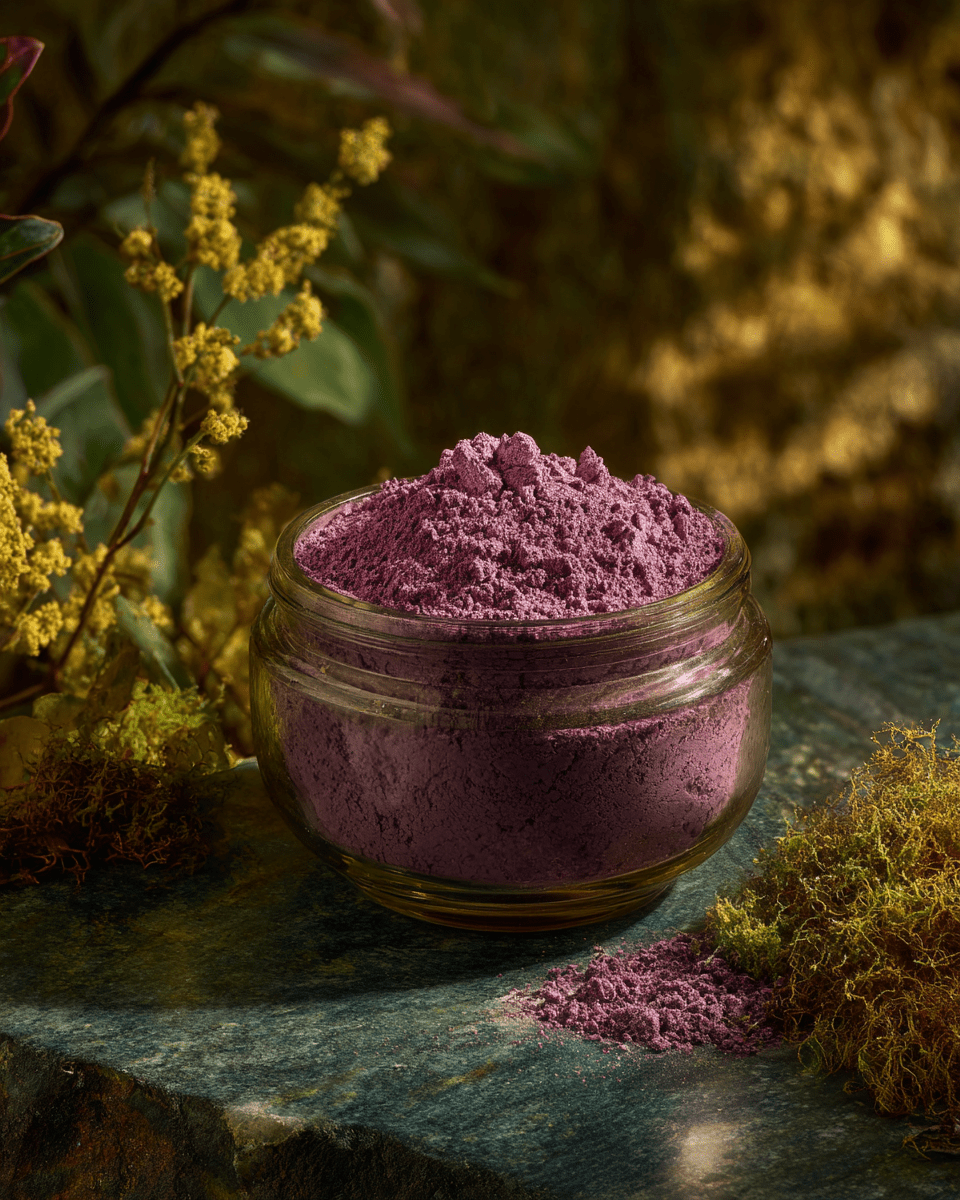
Prickly pear powder is obtained by gentle drying and grinding of the pulp of the Opuntia ficus-indica fruit, the prickly pear cactus. It should not be confused with the oil extracted from the seeds: the latter is lipidic, rich in linoleic acid and sterols. The powder, on the other hand, is a hydrophilic and polar fraction, whose value lies in several distinct families of components:
1. Mucilaginous polysaccharides form the backbone of the active ingredient. Arabinose, galactose, and glucuronic acid assemble into branched chains known for their high capacity to capture and retain water. These mucilages form a comfortable film on the skin's surface, which helps limit surface dryness without clogging pores—a particularly appreciated property for mature and dehydrated skin.
2. Betalains—yellow-orange betaxanthins and red-violet betacyanins—are natural nitrogenous pigments (non-flavonoids) traditionally associated with prickly pear pulp. These pigments contribute to the fruit's characteristic color and to the powder's sensory profile.
3. Pectin (about 60% of total fibers) acts on two levels: topically, it forms a viscoelastic matrix that complements the film-forming action of mucilages; in a mask or prolonged application, it creates a hydrated microenvironment that extends skin comfort.
4. Natural antioxidant components are part of Opuntia pulp's heritage, a documented natural source, distinct from recombinant or synthetic ingredients used in some high-end formulas.
5. Minerals—calcium, magnesium, potassium—complete the picture. They contribute to the powder's natural mineral profile, valued for supporting daily skin comfort.
Betalains and minerals: the visible radiance and firmness assets of Opuntia powder
Mature skin is exposed to various external factors: UV, pollution, tobacco, as well as the visible effects of time, which often lead to a less firm appearance and a duller complexion. With age, visible signs tend to intensify (appearance of fine lines, visible loss of firmness, dull complexion).
Prickly pear powder is valued for supporting the daily appearance of the skin. Betalains, natural nitrogenous pigments, and all the components of the powder contribute to its cosmetic profile, renowned for helping skin maintain a radiant appearance.
This richness explains the powder's "radiance and visible firmness" profile, traditionally described in cosmetic phytochemistry. The skin gradually regains a more even radiance, and the dull appearance of the complexion seems reduced.
To delve deeper into radiance and firmness strategies adapted for mature skin, our comprehensive guide analyzes key active ingredients and usage protocols.
Mucilaginous polysaccharides and pectin: comfortable hydration and "second skin" effect
Hydration of mature skin is not limited to superficial water supply. It benefits from care that helps preserve the comfort of the epidermal barrier—whose appearance evolves with age, menopause, and repeated exposure to irritants. The mucilaginous polysaccharides of Opuntia powder play a structuring role here.
By depositing on the stratum corneum, they form a porous hygroscopic network: a true "second skin" that captures ambient humidity while helping to limit surface dryness. This film-forming property is noticeable: in a 15-minute mask, a sensation of superficial skin hydration is observed, lasting several hours after rinsing—a comfort effect achieved by physical surface action (rather than receptor-dependent).
Pectin, for its part, provides a slight viscosity that optimizes the spread and contact time of the powder on the skin. In a mask, it prolongs the sensation of hydration and promotes good distribution of betalains by maintaining a slightly acidic pH (compatible with the physiological skin pH of 4.7 to 5.5).
These properties are particularly appreciated for skin concerned with radiance and firmness prevention from the age of forty, when the appearance of the dermis begins to evolve.
Prickly pear powder mask protocol for mature and dull skin
Prickly pear powder is ideally suited for masks, a format that maximizes contact time and mucilage activation. Here is the recommended protocol for mature, dull, and lacking firmness skin:
Frequency: 2 to 3 times a week as an intensive treatment (4 weeks), then once a week for maintenance.
Preparation: In a clean bowl (ceramic or glass preferably, to avoid alteration of betalains in contact with metals), mix:
- 1 level teaspoon of Nopal Life prickly pear powder
- 1 teaspoon of rose water (or helichrysum floral water for very mature skin)
- 2 to 3 drops of prickly pear oil (lipid/polar synergy, optional)
Application: On clean, slightly damp skin. Spread a thin layer on the face and neck (avoiding the eye contour). Leave on for 12 to 15 minutes. The pectin will slightly gel on contact with the skin—this is normal and a sign of mucilage activity.
Rinsing: With lukewarm water (never hot, to preserve remaining betalains), followed by a light splash of cold water to tighten the appearance of pores. Finish by applying your usual skincare product on still slightly damp skin.
Expected results: From the first application, a noticeable "smoothed skin" effect. After 3 to 4 weeks of treatment, a more even-looking complexion, reduced dullness upon waking, and a more toned appearance of the skin surface. These effects concern skin appearance and comfort—they do not replace a dermatological assessment for specific concerns.
To precisely identify your skin's needs and personalize your routine, Nopal Life's AI Skin Intelligence skin diagnostic guides you to the most suitable active ingredients for your skin profile.
Mistakes to avoid with prickly pear powder
1. Using a metal bowl or spoon. Metal ions (iron, copper, zinc) can alter betalains and change their hue even before application. Always use glass, ceramic, or food-grade plastic.
2. Preparing the mask in advance. Once mixed with water, the powder deteriorates quickly. Prepare the quantity at the time of use; never store the wet mixture.
3. Applying to dry skin without prior humidification. Mucilages need water to activate and form their film-forming network. Dry skin absorbs the first water molecules before the polysaccharides can organize themselves—thus losing part of the effect.
4. Leaving it on for more than 20 minutes. Beyond this, betalains can leave a slight, temporary pink pigment on very fair skin. 12-15 minutes is optimal.
5. Rinsing with hot water. Heat can alter the powder's components and destabilize betalains. Use lukewarm water, then cold water—never boiling water or steam.
6. Confusing powder and oil in homemade skincare formulations. The powder is hydrophilic—it does not disperse in pure oil. If you want to combine it with an oily base, you must first disperse it in an aqueous phase, then incorporate the emulsion. Without this precaution, the polysaccharides remain in inert suspension.
7. Neglecting storage. Dry powder should be stored away from moisture, light, and heat. An opaque airtight jar in a cool cupboard preserves its qualities for 12 to 18 months. Powder that has browned or developed a rancid odor has deteriorated—it should not be used on the skin.
Discover our entire range of plant powders and cosmetic minerals formulated with the same integrity requirements.
Integrate prickly pear powder into a complete P1 routine
Prickly pear powder fits into a P1 skincare logic—Priority 1 Protocol—adapted for mature, dull, and lacking firmness skin. It plays the role of a "weekly booster" active in a structured daily routine:
Morning: Gentle cleansing → floral toner → prickly pear oil (lipid phase) → sun protection. The powder is not used in the morning—its mask format requires a setting time incompatible with a quick routine.
Evening (days without mask): Double cleansing if wearing makeup → aqueous serum rich in hydrating active ingredients → prickly pear oil for occlusion.
Evening (days with mask, 2-3×/week): Double cleansing → prickly pear powder mask 12-15 min → lukewarm/cold water rinse → light oil application. The mask replaces the serum: betalains and mucilages alone provide a sufficient level of active input.
This structure respects the hierarchy of active ingredient application (from lightest to most occlusive) and promotes good distribution of polysaccharides without "blocking" them under a prior oily phase. For skin that requires a specific approach with prickly pear powder, we recommend starting the treatment without any other exfoliating active ingredients (AHA, retinol) on the same night, to avoid discomforting the skin.
Nopal Life prickly pear powder is available in a 50g format—sufficient for a full 4-week treatment at 3 masks per week, with a dosage of 1 tsp per application.
Order prickly pear powder Get my free skin diagnostic
FAQ — Prickly Pear Powder: Your Questions, Our EEAT Answers
Q: Is prickly pear powder suitable for oily or combination skin, or only for mature skin?
A: It is universal in its hydrating mode of action (mucilages provide comfort without greasiness), but its cosmetic profile is particularly appreciated for mature and dull skin seeking radiance. On oily skin, it is suitable as a mask, provided no oil is added to the preparation.
No particular documented precautions currently exist for external cosmetic use.
Q: Can betalains color the skin?
A: A slight, transient pink pigment is possible on very fair skin if the mask exceeds 20 minutes. It disappears upon rinsing. Adhering to the recommended application time (12-15 min) avoids this effect.
Q: What is the difference between prickly pear powder and oil in cosmetics?
A: The oil (extracted from seeds) is lipidic: linoleic acid, vitamin E, sterols—excellent in the oily phase, occlusive, nourishing. The powder (dried pulp) is hydrophilic: polysaccharides, betalains, pectin—active in aqueous masks, film-forming, for a more radiant complexion. The two are complementary and can be integrated into the same routine (powder mask in the evening, oil as a finish).
Q: How long until visible results are seen?
A: The "smoothed skin" effect is noticeable from the first application (mechanical action of mucilages). For lasting visible effects—radiance, firmness, complexion uniformity—allow 3 to 4 weeks of regular use (2-3 masks per week).
Q: Can prickly pear powder replace a hyaluronic acid serum?
A: It is not a direct equivalent—hyaluronic acid primarily acts sustainably within the epidermis, while Opuntia mucilages act on the surface through a physical film. The two approaches are complementary, not substitutable. The powder is ideal as a weekly boost; a daily HA serum remains relevant as a supplement for very dehydrated skin.
Q: Is prickly pear powder certified organic?
A: Nopal Life powder comes from prickly pear cacti grown without chemical inputs under conditions close to organic standards. For any questions regarding traceability and certifications, our team is available via the contact page on the website.
Q: Can I mix the powder with my usual clay mask?
A: Technically yes, but with precautions: clay (smectites, kaolinite) has a basic pH that can destabilize betalains (stable between pH 4 and 6). Prefer white clay (kaolin, neutral pH) rather than green or red clay. The mixture works, but the appearance of betalains will be partially modified compared to a powder-only mask.
Why choose Nopal Life to support skin appearance
Supporting the appearance of visible signs of aging involves carefully selected active ingredients. Nopal Life prickly pear oil, rich in essential fatty acids omega-6 and omega-9, vitamin E, and plant sterols, helps preserve the skin's suppleness and the appearance of the skin's film. It contributes to the skin's firm and plump appearance, helps reduce the appearance of dehydration fine lines, and supports the comfort of the epidermal barrier for a visible smoothing effect from the first weeks.
Pair it with our night cream and serum for a complete synergy, day and night. Your skin regains a firm, radiant appearance and lasting comfort. Discover the Nopal Life formulation designed for your skin profile with our free Skin Intelligence diagnostic.
RECOMMENDED TREATMENT
Natural formula · Origin Algeria
DISCOVER THIS TREATMENT →PERSONALIZED ROUTINE
Nopal Life Skin Intelligence™
Free diagnostic · 2 minutes
DISCOVER MY ROUTINE →Information provided for cosmetic and educational purposes; it does not constitute medical advice.
Read more


Go further than this article
Get our skincare guides by email — and start with your free skin diagnostic: 2 minutes, advice tailored to your skin. We ship to the US, UK, Canada, Australia and 27 European countries; somewhere else? Sign up and you will be the first to know when we deliver to your country.
By signing up, you agree to our privacy policy. Unsubscribe in one click.