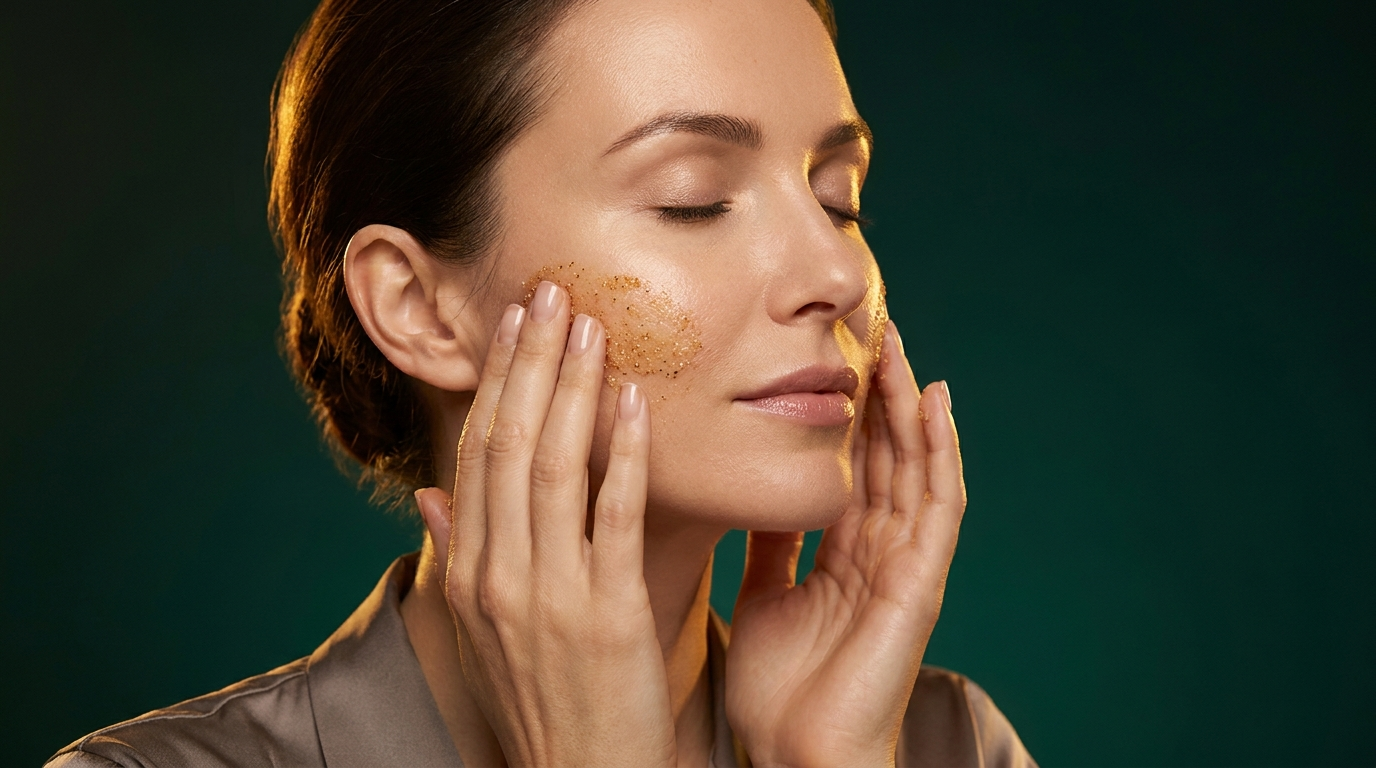
Homemade Hydrating Face Mask: 9 Formulas for Different Skin Types
A successful homemade moisturizing mask combines three things: water, an ingredient that retains it, and a small fatty fraction that prevents it from evaporating. That's all. Recipes that fail are almost always those that contain only one of the three — a cucumber mask alone provides water that evaporates in ten minutes, a pure coconut oil application provides no water. Nine numbered formulas follow, with exact proportions, application times, and kitchen ingredients that should never be put on the face.
The three functions to combine
Water humidifies the stratum corneum. It comes from aloe gel, yogurt, grated vegetables, or simply a spoonful of added water.
The humectant retains it. Glycerin and honey are hygroscopic: they bind water molecules and slow their evaporation. Without them, the hydration doesn't last.
The emollient forms a light film that limits evaporation. Half a teaspoon of jojoba oil, sweet almond oil, or squalane is sufficient — more makes the preparation greasy without improving the result.
A point of attention regarding humectants: in very dry air, heating in winter or air conditioning, a humectant used alone can draw water from the deeper layers of the epidermis instead of capturing it from the air. This is precisely why the fatty fraction is not optional. See our page on vegetable glycerin and our skin hydration module.
Nine formulas according to skin type
| Profile | Aqueous base | Humectant | Fatty substance | Application time |
|---|---|---|---|---|
| Normal skin | 1 tbsp aloe gel | 1 tsp honey | 1/2 tsp jojoba | 10 min |
| Dry skin | 2 tbsp plain yogurt | 1 tsp honey | 1 tsp sweet almond | 12 min |
| Very dry skin | 1/2 mashed avocado | 1 tsp glycerin | 1 tsp olive | 15 min |
| Dehydrated skin | 1 tbsp aloe gel | 1 tsp glycerin | 1/2 tsp squalane | 10 min |
| Combination skin | 1 tbsp yogurt | 1/2 tsp honey | 1/2 tsp jojoba | 10 min |
| Oily skin | 2 tbsp aloe gel | 1/2 tsp glycerin | 1/4 tsp jojoba | 8 min |
| Sensitive skin | 1 tbsp aloe gel | 1/2 tsp glycerin | 1 tsp colloidal oatmeal | 8 min |
| Mature skin | 2 tbsp yogurt | 1 tsp honey | 1 tsp argan | 15 min |
| After sun | 2 tbsp aloe gel | 1/2 tsp glycerin | 1 tsp colloidal oatmeal | 10 min |
The proportions are not indicative: a teaspoon is about five milliliters, a tablespoon fifteen. Measuring rather than estimating "a little" makes the recipe reproducible, which is the only way to know if it suits you.
Each line provides a single dose for one face. Do not double: a thick layer extends rinsing without improving anything.
Three detailed recipes
Aloe, honey, and jojoba — the basic formula. Mix one tablespoon of cosmetic aloe vera gel, one teaspoon of liquid honey, and half a teaspoon of jojoba oil. Whisk for thirty seconds: the honey must be completely dispersed, with no visible strands. Apply a thin layer to a clean face, leave for ten minutes, rinse with lukewarm water.
Yogurt and avocado — for very dry skin. Mash half a ripe avocado with a fork until smooth, add one tablespoon of whole plain yogurt and one teaspoon of olive oil. Avocado provides lipids similar to sebum; yogurt provides water and protein. Fifteen minutes, remove with a damp cloth rather than running water, as the texture is thicker.
Aloe and oatmeal — for reactive skin. Two tablespoons of aloe gel, one teaspoon of colloidal oatmeal, half a teaspoon of glycerin. Colloidal oatmeal genuinely soothes — it's one of the few kitchen ingredients with documented anti-irritant effects. Eight minutes, no more, and without massaging when removing.
Three variations with other natural ingredients
These homemade mask recipes expand the base without changing the logic: an aqueous phase, a humectant, a fatty fraction.
Banana and honey, for dull skin. Mash half a very ripe banana until smooth, add one tablespoon of honey and one teaspoon of sweet almond oil. Banana provides water, humectant sugars, and a texture that stays on the skin without dripping. Apply to a clean face, leave on for twelve minutes, then rinse with lukewarm water. Really mash it: an uncrushed piece requires rubbing when removing.
Green clay and aloe, for a shiny T-zone. One level teaspoon of green clay, two teaspoons of aloe gel, half a teaspoon of glycerin. Apply to the face only on the forehead, nose, and chin — never on dry cheeks. Leave on for a maximum of six minutes and dampen before rinsing. Green clay is more absorbent than kaolin: reserve it for genuinely oily skin, and never let it dry to the point of cracking.
Cucumber and yogurt, for a refreshing effect. Finely grate a quarter of a cucumber, press to remove excess juice, mix with one tablespoon of yogurt and half a teaspoon of glycerin. Apply to the face, leave on for ten minutes, then rinse. Cucumber is essentially water: without glycerin and yogurt, the hydration leaves in a few minutes — this is the classic mistake of a cucumber mask alone.
For all these variations, the same preparation rule applies: a single dose, a clean bowl, no leftovers kept.
What you should never put on your face
- Lemon. Its pH close to 2 is incompatible with the skin, and it is photosensitizing: applied before exposure, it causes burns and lasting spots.
- Baking soda. pH 9, abrasive, it destroys the hydrolipidic film.
- Vinegar, even diluted: uncontrollable acidity from one bottle to another.
- Toothpaste on pimples: detergents and menthol on already inflamed skin.
- Sugar and salt on the face: sharp edges, micro-lesions.
- Cinnamon and chili pepper, which cause clear contact dermatitis.
These ingredients appear in online recipes because they produce a strong sensation, immediately interpreted as an effect. The sensation is a symptom of aggression, not proof of action.
Honey requires a different kind of reservation: it is a recognized contact allergen, especially in people sensitive to pollen or hymenopteran venom. Test beforehand.
Hygiene and preservation: the single rule
A homemade preparation cannot be stored. It contains water, no preservative system, and has been handled with fingers. It is an ideal culture medium, and the refrigerator slows proliferation without preventing it.
Prepare a single dose in a clean bowl, with a washed spoon, and discard any leftovers. Never store "for next time," even for twenty-four hours.
This point is not a precautionary principle. A contaminated preparation applied to recently cleansed, possibly micro-lesioned skin, exposes one to reactions that have nothing to do with cosmetics.
Wash your hands before preparation, and use fresh ingredients — yogurt opened a week ago or rancid oil are not suitable.
Application and removal
Cleanse your face for thirty seconds with a mild product, rinse, pat dry. Apply the preparation within five minutes: the skin retains what is applied better during this window.
Spread in a thin, even layer, avoiding the eye contour by a good centimeter — the skin there is less than a millimeter thick and cannot tolerate pulling or occlusion.
Keep the mask moist. If it starts to dry, spray a little water or moisten your fingers. A cracking mask stops providing water and starts drawing it out — this is the mechanism that explains the tight feeling after too long an application.
Remove with lukewarm water, emulsifying with your fingers for greasy preparations, never with a rough towel. Friction during removal irritates more than the preparation itself.
Finish with a humectant serum and then a cream, within two minutes.
Choosing your recipe based on what you're looking for
A homemade face mask doesn't do everything, and knowing what you expect from the action avoids unnecessary preparations.
To hydrate your skin in the strict sense — to provide it with water and retain it — formulas based on aloe gel, glycerin, and a small fatty fraction are the most direct. This is the objective of the main table.
To nourish, which is not the same thing, you need to increase the lipid content: avocado, argan oil, olive oil. Dry skin lacks fatty substances; dehydrated skin lacks water. The two states often coexist, which explains why complete recipes combine both contributions.
To soothe your skin after exposure or mild irritation, colloidal oatmeal and aloe gel are sufficient. Mix them until a smooth paste is obtained, apply without massaging, leave on for eight minutes before rinsing. This is also the aloe vera cucumber combination, in a more stable version, which is best suited for reactive skin.
These preparations remain easy to make and inexpensive, but they contain no measured active ingredients. This is their advantage — few variables, therefore few risks — and their limitation.
Test before, evaluate after
The preliminary test takes five minutes and avoids most unpleasant surprises: apply a small amount behind the jaw, leave for five minutes, rinse, then wait twenty-four hours. For reactive skin, forty-eight hours — some reactions are delayed.
For evaluation, there is only one rule: do not judge immediately after leaving the bathroom. All skin is temporarily supple after rinsing, regardless of what was applied. The useful benchmark is comfort at thirty minutes, and the appearance the next morning.
Start once a week and change only one parameter at a time. If you modify the recipe, duration, and frequency together, no conclusion is possible.
And if the skin tightens, reddens, or stings after application, the recipe is not suitable — do not insist by reducing the duration. See our page on sensitive skin.
What these recipes cannot do
They improve suppleness and comfort for a few hours. This is a real benefit, and it is their limit: they do not change skin type, which depends on genetics and sebum production.
They do not replace a preserved and tested formula, especially on very reactive skin. Kitchen ingredients have variable compositions from batch to batch and may contain undeclared allergens.
They do not act on established wrinkles, spots, or pore size.
And none replace a daily cream and sun protection — a weekly mask does not compensate for six days without care. Cracks, persistent discomfort, or redness that does not subside require professional advice.


Go further than this article
Get our skincare guides by email — and start with your free skin diagnostic: 2 minutes, advice tailored to your skin. We ship to the US, UK, Canada, Australia and 27 European countries; somewhere else? Sign up and you will be the first to know when we deliver to your country.
By signing up, you agree to our privacy policy. Unsubscribe in one click.