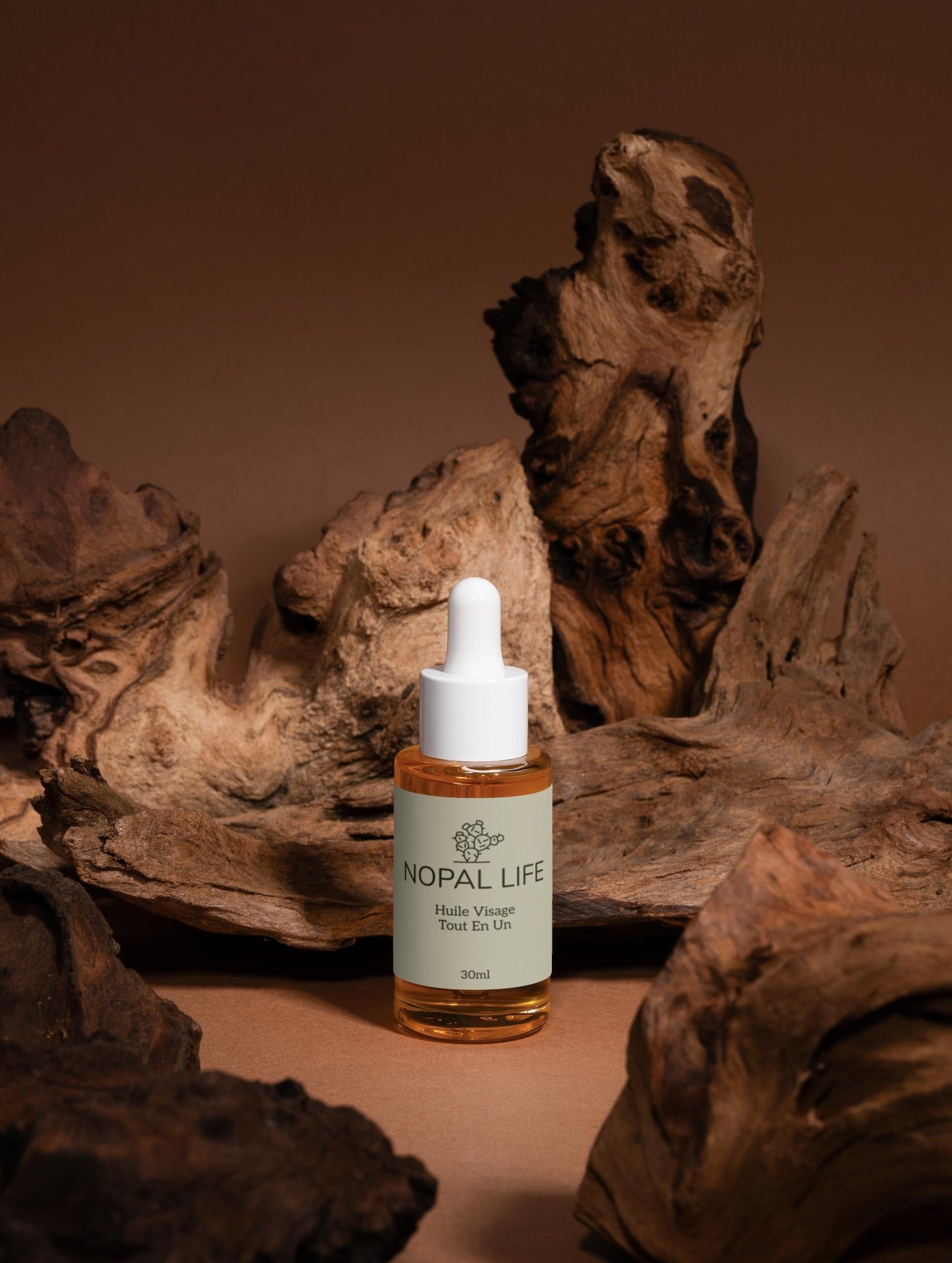
Combine rosehip oil and jojoba oil
This is one of the rare combinations where one genuinely protects the other. Rosehip oil is rich and fragile; jojoba oil is poor in essential fatty acids but remarkably stable. When mixed, the latter slows down the oxidation of the former.
Key Points
- Proportions: one part rosehip oil to one or two parts jojoba.
- Mixing: in the palm of your hand, just before application.
- Total Quantity: 2 to 3 drops for the face.
- Time: preferably in the evening.
- Storage: rosehip in the refrigerator, jojoba at room temperature.
Why this duo works
Rosehip oil owes its value to its richness in essential fatty acids, including a rare omega-3 in cosmetics. This also makes it fragile: polyunsaturated fatty acids oxidize quickly.
Jojoba is not strictly speaking an oil but a liquid wax, composed of esters. This structure explains why it practically doesn't go rancid — and why it slows down the oxidation of what it's mixed with.
You therefore get the profile of rosehip oil with better stability, at a lower cost since jojoba takes up part of the volume.
Jojoba is a liquid wax, similar to human sebum; rosehip is an oil rich in linoleic acid and omega. One regulates, the other nourishes — two distinct functions combined in one bottle.
It's a natural and stable combination, where jojoba extends the lifespan of the other. Thus accompanied, Rosa rubiginosa delivers its benefits without imposing its fragility.
Finding the right proportions
Dry or mature skin: two drops of rosehip oil to one of jojoba. The contribution is paramount.
Normal skin: half-and-half.
Combination or blemish-prone skin: one drop of rosehip oil to two of jojoba, whose lightness is better accepted.
The adjustment guideline is simple: ten minutes after application, the skin should be supple without shine. If it's still shiny, reduce the amount of rosehip oil.
One part rosehip to three parts jojoba for combination skin; half-and-half for dry skin. As jojoba is a very stable wax, it also acts as a carrier: the higher its proportion, the longer the mixture lasts.
Rosa rubiginosa oil can be used pure on dry mature skin, but its linoleic acid oxidizes quickly. Diluting it is as much about preservation as it is about texture, and this is the least often cited reason.
Mix, don't pre-prepare
Mix it in the palm of your hand, just before applying it. Preparing a bottle in advance means exposing the rosehip oil to air for weeks, which cancels out the desired stability benefit.
If you insist on a ready-made bottle, make it in a small quantity, in tinted glass, and keep it in the refrigerator.
The protocol
After cleansing, pat dry without wiping: the skin should remain slightly damp. Place the drops in the palm of your hand, warm for a few seconds, then apply by pressing from the center outwards.
Only one drop of the mixture on the eye contour, dabbed with the tip of the ring finger. On perfectly dry skin, the two oils seal a surface that has nothing to retain.
The benefits of rosehip oil in this duo
The expected benefits of rosehip oil concern skin suppleness and surface uniformity, with visible results in three to four weeks. Jojoba doesn't contribute to this: it accompanies.
This is important when dosing. Reducing the amount of rosehip oil to less than a drop is equivalent to applying only jojoba, with the price of the former and the effect of the latter.
It provides what jojoba doesn't: linoleic acid and omega in quantity, as well as carotenoids. Jojoba, for its part, provides stability and lightness.
Using Rosa rubiginosa oil in this mixture allows you to reap its benefits without suffering its fragility. It is a natural association in the strict sense: two vegetable fats, nothing else, and a simple application.
According to skin types
Sensitive skin: start with jojoba alone for two weeks, then introduce rosehip oil. It is the latter, and not the former, that can cause problems if it has gone bad.
Dry skin: the complete combination, morning and evening, with a cream on top in winter.
Oily skin: one drop of the mixture, dosed towards jojoba, only on areas that feel tight.
On dry mature skin, half-and-half in the evening. On combination skin, one part rosehip to four parts jojoba, on the cheeks only. On oily skin, jojoba alone — the addition brings nothing measurable.
These proportions are adjusted by feel after one week. This is the only reliable method: skin type provides the starting point, tolerance provides the final adjustment.
On hair
Jojoba dominates here: it is applied up to the roots, which is not recommended with most vegetable oils. Rosehip oil would be a waste here, given its price and fragility.
So keep the mixture for the face and décolleté, and jojoba alone for the lengths.
The mixture is suitable for damaged ends, in very small quantities on towel-dried lengths. Jojoba provides lightness, rosehip provides the fatty acids that the fiber has lost.
Avoid on oily scalp. Reserving treatment for the lengths remains the rule, and this mixture is no exception despite its more fluid texture than that of an oil alone.
Storage, the decisive point
Rosehip oil oxidizes quickly: small bottle, tinted glass, refrigerator after opening. A pungent odor signals that it has turned, even if its appearance hasn't changed — and oxidized oil irritates instead of nourishing.
Jojoba can be kept for years without precaution. Buy it in a larger format without fear: that's where you'll save money, not on the other.
Prepare small quantities: ten milliliters at a time, consumed within three weeks. A mixture prepared for three months will have turned before it's finished.
As jojoba is a virtually non-oxidizable wax, the proportion of rosehip determines the shelf life. Its natural use, without preservatives, imposes this discipline — and an opaque bottle in the refrigerator gains a few more weeks.
What this duo doesn't do
It doesn't hydrate in the strict sense: two fatty substances retain existing water without adding any. On dehydrated skin, add a humectant underneath.
It doesn't act on spots or established wrinkles. Its domain is suppleness, comfort, and surface quality.
It does not erase an established mark or change the skin's structure. What it improves is the quality of the surface film and the resulting comfort.
Nor does it replace water intake. These two fats retain what is present; they do not add a drop.
What you need to know
These oils are cosmetic and improve the appearance and comfort of the skin, without curative intent. A mark that changes in shape or color requires medical advice.
Our anti-aging treatments