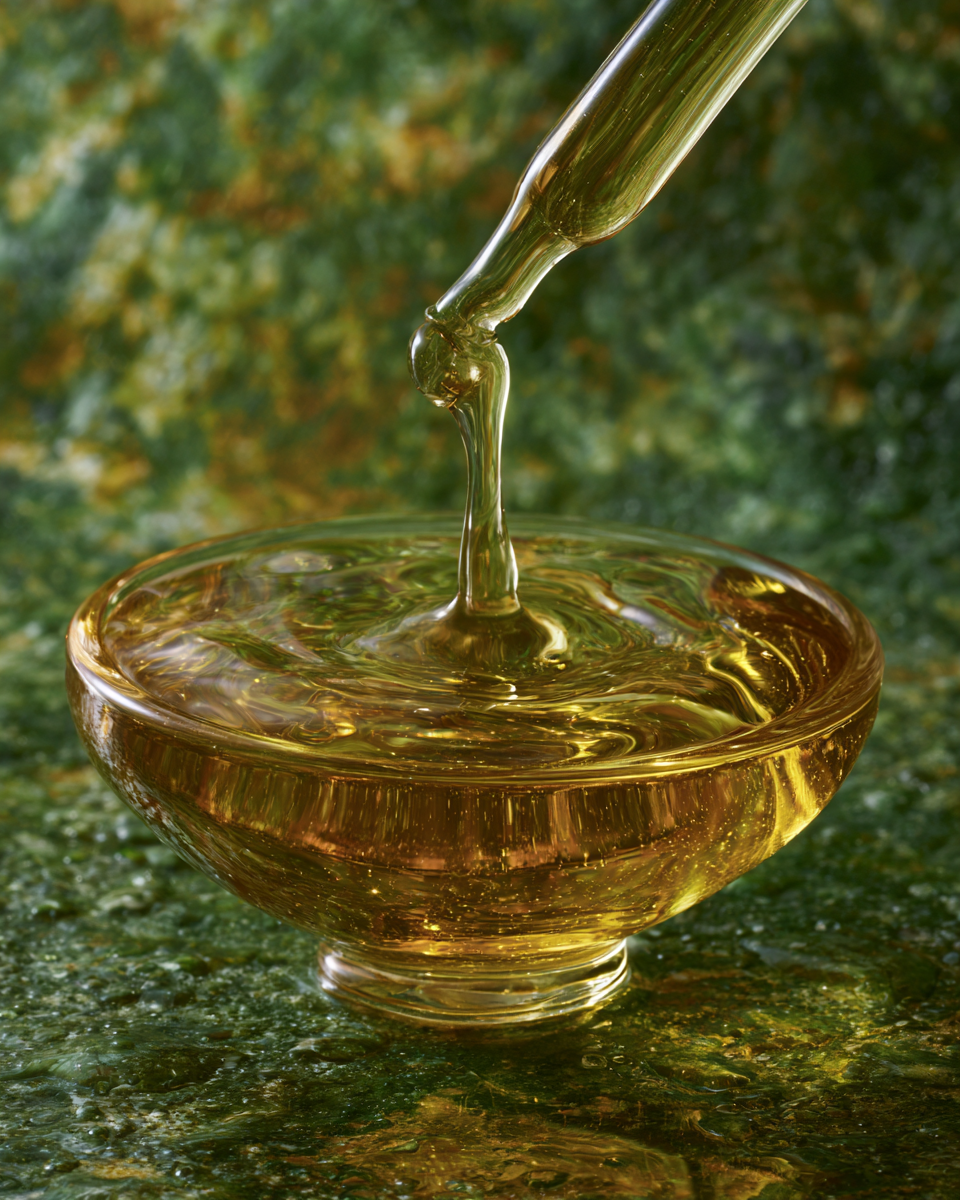
Glycerin morning or night: when to apply it
For glycerin, the timing does not matter — what you put on top does. And this topping is not the same in the morning and in the evening. That's where the whole question lies.
Why timing doesn't matter
Glycerin is a humectant: it attracts water and retains it in the superficial layers. This mechanism does not depend on light, skin rhythm, or temperature. It does not degrade, is not photosensitizing, and has no incompatibilities.
It is one of the few ingredients about which this can be said. The "morning or evening" question arises for fragile or powerful active ingredients; here, it does not arise in these terms.
The real question: what comes next
A humectant alone, in dry air, draws water from the lower layers of the skin instead of providing it. It must be covered. And what covers is not the same product in the morning and in the evening.
In the morning, it's a light moisturizer followed by sun protection. In the evening, it can be a richer cream or an oil. In both cases, glycerin does the same job, but the result depends entirely on the next step.
In the morning, in practice
Cleansing, toner or serum containing glycerin on still-damp skin, cream, sunscreen. The texture should remain light: beyond ten percent glycerin, a sticky finish interferes with makeup and sun protection hold.
On oily skin, a gel is enough to cover. On dry skin, a richer cream is necessary — glycerin alone under a sunscreen does not last the day in winter.
In the evening, in practice
Cleansing, aqueous phase, then a cream or oil as the last layer. This is when the concentration can increase, as the question of texture under makeup no longer arises.
For dry skin, doubling the application — morning and evening — provides a real gain in comfort. For oily skin, once is usually enough, and preferably in the evening if one has to choose.
According to skin types
Dry skin: morning and evening, five to ten percent, under a fatty substance. Oily skin: once a day, three to five percent, under a gel. Combination skin: in the morning over the entire face, in the evening on the cheeks with a richer cream. Sensitive skin: without restriction, it is the best tolerated humectant on the shelf.
Diluting with water or rose water is the rule if you start with pure glycerin: one teaspoon in one hundred milliliters gives approximately five percent. Applied neat, it produces the opposite of the desired effect, at any time.
What timing won't fix
A lack of lipids. Glycerin does not provide fatty substances and does not strengthen the skin barrier in the way ceramides do. If the skin feels tight despite a well-constructed routine, it is the emollient step that needs to be reviewed, not the timing.
Our hydrating day cream covers the morning routine, the light hydrating gel covers combination skin, and the vegetable glycerin sheet details the concentrations.
The order of layers, morning and evening
A routine is built from the most fluid to the thickest. Cleanser, aqueous phase, serum, cream, and in the morning, a sunscreen last. This order is not an aesthetic convention: each layer must be able to reach the skin before the next prevents it.
Applying an aqueous product over a fatty substance is like applying it to a surface it will not penetrate. This is the most common and easiest mistake to correct, and it explains many disappointing results attributed to the products themselves.
The role of each step
Cleansing prepares, without stripping: a face that feels tight after rinsing has been washed too harshly. The aqueous phase provides water. The cream provides lipids and limits evaporation. The filter protects against the main cause of visible aging.
Four positions, four functions, none interchangeable. An effective routine covers all four; a long routine that misses one is no better than a short routine that covers them all.
Adapt according to daily needs
A heated environment in winter, a plane, an air-conditioned office: in these conditions, the air contains little water and the sealing layer becomes crucial. A richer texture in the morning changes comfort more than an additional active ingredient.
Conversely, in summer and humid weather, a light texture is sufficient and excess becomes counterproductive: pores are more noticeable under a thick film, and makeup holds less well.
Simplify rather than layer
You can mix two compatible textures in your palm to reduce the number of steps — a hydrating base and a few drops of oil, for example. It is best not to do this with an acidic product or a sunscreen, whose dosage and pH are carefully calculated.
Reducing the number of steps is often the best way to improve a routine. A simple base applied twice a day for six months yields better results than eight products used irregularly.
Masks and occasional treatments
A hydrating mask is applied in the evening, after cleansing and before other treatments. A clay mask is used once a week, on the affected area, and rinsed before the preparation dries completely — a cracking clay pulls on the skin.
These occasional treatments do not replace any daily steps. They are in addition, and their effect is measured in hours for comfort, not in weeks for appearance.
The health of the surface, how it shows
Skin that is smooth to the touch, supple, doesn't feel tight after cleansing, and doesn't shine unevenly. These four signs are worth more than an immediately radiant complexion, which may only be a texture effect.
They are obtained through consistency rather than novelty. It is not spectacular, and that is what successful routines have in common.
How long before judging a routine
A few days for comfort, six to eight weeks for appearance, three months for complexion and marks. These three timelines are different, and confusing them leads to changing products before measuring anything.
The reliable method is to photograph your face at the same time, in the same place, without makeup, every four weeks. The daily mirror shows no slow change; two photographs two months apart show a lot.
What matters more than product choice
Do not strip during cleansing. Consistently cover an aqueous phase. Protect from the sun every day of the year. Introduce one active ingredient at a time, with three weeks between each addition. These four rules do more than any formula.
They also explain why two people using the same products get different results. How they are used weighs at least as much as their composition, and it costs nothing.
Adapt to the seasons
In winter, heated indoor air often drops below thirty percent humidity. The sealing layer must be richer, and the aqueous step more generous. In summer, the opposite: light textures, and particular attention to protection.
These adjustments are made by texture, not by the number of steps. Switching from a gel to a cream and vice versa is sufficient in the vast majority of cases; adding products complicates without improving.
When a routine is no longer enough
Permanent redness without a triggering factor. Persistent itching. Extensive or painful blemishes. In these three cases, cosmetic care does not address the situation, and the advice of a healthcare professional is necessary.
Delaying it helps no one. Cosmetics address ordinary cases, well and durably, and that is already what most faces need.
Judging a treatment without misjudging the timeline
Three timelines coexist in a routine, and confusing them leads to giving up too early. Comfort returns in a few days. Surface appearance evolves over six to eight weeks. What affects complexion and marks takes at least three months.
The reliable method comes down to one habit: photograph your face at the same time, in the same place, without makeup, every four weeks. The daily mirror shows no slow change; two photographs two months apart show a lot.
What matters more than product choice
Do not strip during cleansing — a face that feels tight after rinsing has been washed too harshly. Consistently cover an aqueous phase. Protect from the sun every day of the year. Introduce one active ingredient at a time, with three weeks between each addition.
These four rules explain why two people using the same products get different results. How they are used weighs at least as much as their composition, and it costs nothing.
Adapt to the seasons
In winter, heated indoor air often drops below thirty percent humidity. The sealing layer becomes crucial, and a richer texture changes comfort more than an additional active ingredient. In summer, the opposite: light textures, and excess becomes counterproductive.
These adjustments are made by texture, not by the number of steps. Switching from a gel to a cream and vice versa is sufficient in the vast majority of cases.
When a routine is no longer enough
Permanent redness without a triggering factor. Persistent itching. Extensive or painful blemishes. In these three cases, cosmetic care does not address the situation, and the advice of a healthcare professional is necessary.
Delaying it helps no one. Cosmetics address ordinary cases, well and durably, and that is already what most faces need.
The "Morning or Evening: When to Apply" Series
For each ingredient, the important moment and the reason that dictates it.
Our anti-aging treatments