Red Prickly Pear: Color, Taste, and Uses
The red prickly pear is primarily an edible fruit whose color comes from water-soluble pigments, not a variety of red oil. It grows on the prickly pear cactus, which is adapted to arid regions and a Mediterranean climate. Understanding the plant, the fresh fruit, and the seed helps to avoid mixing consumption, juice, and cosmetic use.
Recognizing Opuntia ficus-indica without confusing fruit and pad
The most common botanical name is Opuntia ficus-indica. The genus Opuntia includes many species, while ficus-indica refers to the cactus widely cultivated for its fruits and young pads. The plant forms flattened articles that store water and bear thorns or fine, almost invisible glochids.
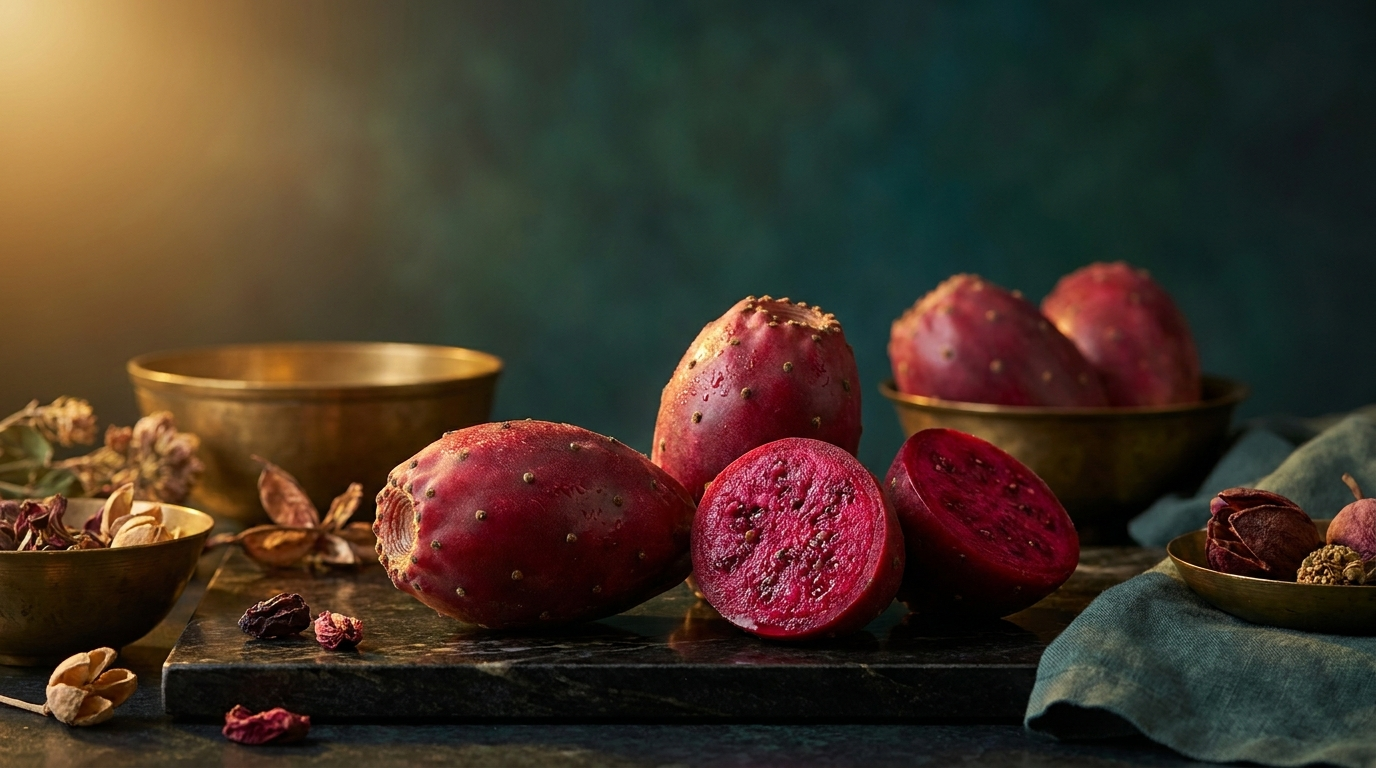
The fruit appears after flowering on the edge of the pads. Depending on the variety and ripeness, its skin and pulp can be green, yellow, orange, red, or purple. The guide on the botany of the prickly pear cactus details this architecture without reducing the nopal to just its fruit.
Why the pulp turns red or purple
The red hue primarily comes from betalains, especially betanin, while yellow shades are more dependent on betaxanthins like indicaxanthin. These pigments are water-soluble, which explains why they easily color juice, hands, and utensils. Their intensity varies with the cultivar, terroir, degree of ripeness, and storage conditions.
A deep color alone does not indicate superior nutritional value. Vitamin C, polyphenols, fibers, and minerals also change depending on the batch. Therefore, real analyses should be compared rather than deducing composition solely from visual appearance.
From cactus to fresh fruit: harvesting, thorns, and preparation
The fruits are harvested when they detach easily and the skin has reached a uniform color. Even when they appear smooth, glochids may still be present. Wear thick gloves, hold the fruit with tongs, cut both ends, then incise the skin lengthwise.
Then, peel back the skin and scoop out the pulp with a spoon. The cut fruit can be stored in the refrigerator in a sealed container and should be consumed quickly, ideally within twenty-four hours after being fully cut. Washing the surface thoroughly before cutting limits the transfer of thorns to the cutting board or knife.
Taste, texture, and place in the diet
The fresh pulp is soft, watery, and dotted with many hard seeds. Its taste can resemble watermelon, pear, or certain red berries, depending on the variety. A common serving corresponds to one or two fruits, but digestive tolerance depends on the quantity of seeds and fiber consumed.
The fig can be eaten fresh, diced, passed through a mill to separate the seeds, or processed into juice. Food consumption does not have the same objective as a skincare product applied to the skin. NOPAL LIFE remains focused on topical cosmetics and does not present the fruit as a supplement.
Red juice, coulis, and domestic preservation
For juice, blend 250 g of pulp with 100 ml of water, then strain through a fine sieve. Only add lemon when serving: its acidity alters the taste and color stability. Keep the preparation chilled and consume within 24 hours, as a homemade recipe is neither pasteurized nor protected by a preservative system.
A coulis requires less water and is suitable for yogurts or desserts. Cooking sometimes darkens pigments and reduces aromatic freshness. Using ripe but undamaged fruit yields a more regular texture and limits fermented notes.
What the seed brings to prickly pear oil
The oil does not come from the red pulp but from small, separated, dried, and then pressed seeds. It mainly contains fatty acids, with a significant proportion of linoleic acid, as well as fat-soluble constituents such as tocopherols. Its color generally ranges from yellow to golden green, never the bright red of the juice.
This distinction is central to understanding prickly pear oil. A colored pulp extract, a maceration, and a seed oil are three different materials. Their INCI, stability, and role in a formula are not interchangeable.
Opuntia ficus-indica: the plant behind the fruit
The prickly pear cactus bears the botanical name Opuntia ficus-indica. It is a cactus of the Cactaceae family, native to Mexico, introduced to the Mediterranean basin in the 16th century—hence its misleading name, which evokes Barbary rather than its continent of origin.
It is called nopal in Mexico, chumbera in Spain, sabra in Israel, hendi in the Maghreb. This diversity of names accompanies a diversity of uses: the entire plant is exploited, not just its fruit.
The genus Opuntia comprises over two hundred species, several of which produce edible fruits. Opuntia ficus-indica is the most cultivated, because it offers the largest fruits and the least spiny pads.
It thrives in hot and arid regions: its metabolism allows it to open its stomata at night, which significantly reduces water loss. This explains its presence in terrains where almost nothing else grows, and the agronomic interest it generates in the face of drought.
A vocabulary point that avoids many confusions when purchasing: the pad — the cladode — is a flattened stem, not a leaf. It is what is consumed as a vegetable, while the fruit is eaten raw. The two yield very different cosmetic products, and a label that does not specify which was used merits suspicion.
What the red pulp provides
The red color is not just decorative: it corresponds to pigments not found in lighter varieties.
These pigments are betalains — betanin for red, indicaxanthin for yellow-orange. They belong to a rare family in the plant kingdom, present in beetroot and only a few cacti, and absent from classic red fruits which owe their color to anthocyanins.
They are among the most studied antioxidants in the fruit. Published works focus mainly on in vitro measurements and dietary consumption; transposing them to skin application would require data that does not yet exist.
Culinary, red pulp is used as a base for syrups, jams, and juices, where its intense color is sought after. Its sugar content is moderate and its taste is milder than that of yellow varieties.
A particularly useful detail to know: betalains are sensitive to heat and light. A jam cooked for a long time loses some of its color and compounds — which is visible to the eye and constitutes an honest indicator of what remains in the jar.
Red and yellow varieties: useful differences
Red varieties offer intense color and an often more pronounced aromatic profile, while some yellow ones appear milder or more floral. These impressions remain sensory and depend on maturity. Fruit size, skin thickness, seed count, and water content are as important as color.
In Mediterranean regions, the choice often depends on local availability and intended use. A fruit destined for juice must be ripe and juicy; a fruit destined for transport must keep its skin intact. The cultivation and terroirs of nopal explain why two fruits of the same color can be very different.
What the red prickly pear does not allow us to conclude
The red prickly pear is not automatically richer, more hydrating, or more effective on the skin than a yellow variety. Color primarily informs about certain pigments, not about all acids, vitamins, or natural compounds. Without batch analysis, any precise hierarchy remains speculative.
Applying fresh juice to the face is not equivalent to using a formulated cosmetic. The pH, microbial contamination, sugars, and absence of preservatives make this action unpredictable. For skin use, prefer an evaluated formula or consult the page dedicated to the skin benefits of prickly pear.
- Handle fruits with gloves and tongs.
- Rinse the skin before any cutting.
- Clearly separate pulp, seeds, and oil.
- Store cut fruit in the refrigerator.
- Avoid direct application of juice to the face.
| Element | Usual color | Primary use |
|---|---|---|
| Red pulp | Red to purple | Fresh fruit, juice, coulis |
| Yellow pulp | Yellow to orange | Fresh fruit, desserts |
| Dried seeds | Beige to brown | Pressing to obtain oil |
| Seed oil | Yellow to golden green | Cosmetic formulation |
The seed, not the pulp
The red color of the fruit comes from water-soluble pigments that have no place in an oil: the cosmetic comes from the seed, not the pulp. That's why cold-pressed prickly pear oil is yellow to golden green and never red—the color here is a reliable indicator.
The product recommended in this article


Mature skin · Dry skin

Go further than this article
Get our skincare guides by email — and start with your free skin diagnostic: 2 minutes, advice tailored to your skin. We ship to the US, UK, Canada, Australia and 27 European countries; somewhere else? Sign up and you will be the first to know when we deliver to your country.
By signing up, you agree to our privacy policy. Unsubscribe in one click.