Retinol Face Cream: how to choose and introduce it
A retinol face cream works on cell renewal, not hydration. This is the distinction that determines whether the product will suit you: retinol speeds up the rate at which skin renews itself, which refines skin texture and reduces the appearance of fine lines and wrinkles — but also exposes you to side effects if introduced too quickly.
How retinol works in a face cream
Retinol belongs to the retinoid family, derivatives of vitamin A. Applied to the skin, it undergoes a double conversion: retinol, then retinaldehyde, then retinoic acid — the only form truly active at the cellular level.
This conversion explains two things. First, the slowness: a retinol cream takes several weeks before its effects are visible. Second, tolerance: each conversion step reduces potency, which makes retinol much better tolerated than retinoic acid prescribed in dermatology.
Once converted, it acts on two levels. In the epidermis, retinol cream stimulates cell renewal and regulates desquamation. Deep down, in the dermis, retinol skin sees its collagen production supported — it is this second mechanism that explains its benefit for signs of skin aging.
Retinol cream, retinol serum: which to choose
| Retinol face cream | Retinol serum | |
|---|---|---|
| Usual concentration | 0.1 to 0.3% | 0.3 to 1% |
| Tolerance | better, the oily phase buffers | more demanding |
| For whom | first approach, dry or reactive skin | skin already accustomed to retinoids |
| Place in routine | replaces night cream | before night cream |
For first-time use, retinol cream is the safest format: the fatty substances it contains slow down penetration and limit irritation. A retinol serum is then justified, once the skin has built up its tolerance.
Retinol and hyaluronic acid: the most useful combination
This is the most relevant duo for skin starting retinoids. Retinol works on renewal, hyaluronic acid on water content — two complementary mechanisms that do not interfere with each other.
The combination of retinol and hyaluronic acid directly addresses retinol's main drawback: dryness and tightness in the first few weeks. Applying a hyaluronic acid product before the retinol face cream, on slightly damp skin, significantly improves comfort without reducing efficacy.
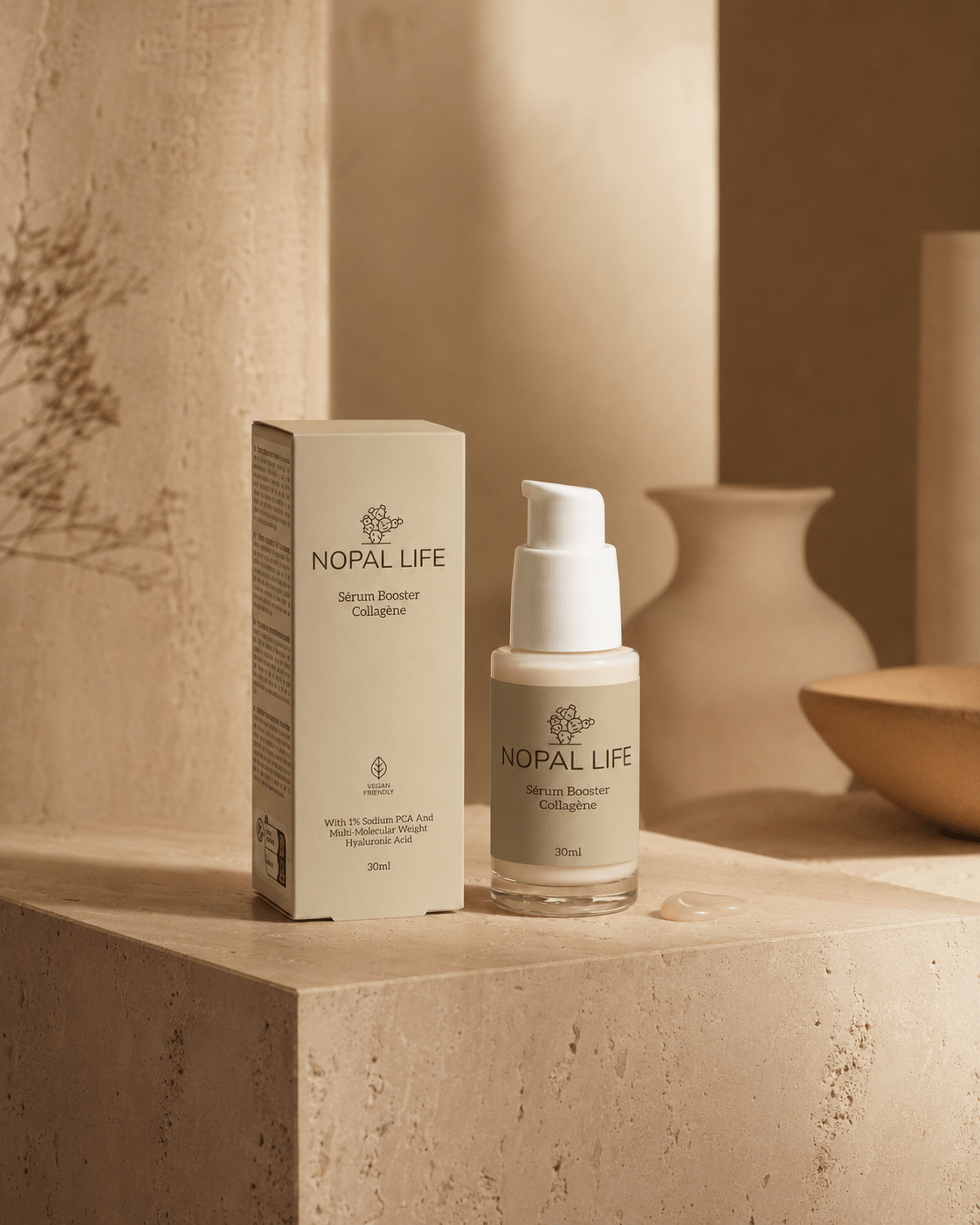
Some formulas combine retinol, hyaluronic acid, and botanical collagen in a single product. The logic holds: renewal, hydration, and suppleness in one step. See our article on the use of hyaluronic acid on the face.
How to introduce a retinol face cream without irritation
Gradual increase is not an optional precaution; it determines success.
- Weeks 1 and 2: two evenings a week, on perfectly dry skin, a pea-sized amount for the entire face.
- Weeks 3 and 4: three evenings a week if no reaction.
- From the second month onwards: every other evening, then daily if the skin tolerates it.
The so-called sandwich method greatly helps reactive skin: a layer of moisturizer, then the retinol cream, then a second layer of moisturizer. It slows down penetration and reduces side effects without canceling the action.
Retinol side effects, and what is normal
An adaptation phase of two to six weeks is common: slight dryness, fine flaking, tightness. This reflects the acceleration of cell renewal and fades over time.
What is not normal, however, includes: persistent redness, burning sensation, discomfort that worsens from week to week. In this case, the frequency is too high or the concentration is too strong — space out applications, do not persevere.
Two absolute rules accompany any retinol face cream. Sun protection the next morning, without exception, because renewed skin is more vulnerable to UV. And use exclusively in the evening, as retinol is light-sensitive.
Contraindications: pregnant and breastfeeding women
Retinoids, derivatives of vitamin A, are not recommended during pregnancy and breastfeeding. This recommendation applies to the entire family, from cosmetic retinol to prescribed forms, and it is consistent in health recommendations.
Pregnant or breastfeeding women who desire a product that acts on the signs of skin aging turn to other active ingredients — bakuchiol, vitamin C, peptides. In case of doubt, the advice of a healthcare professional takes precedence over any label indication.
Retinol alternatives: what other options are worth
Bakuchiol is the most documented retinol alternative. Of plant origin, it does not belong to the retinoid family but activates similar cellular pathways. Its tolerance is significantly better, its action slower and more moderate. Our retinol vs. bakuchiol comparison details this trade-off.
Retinal, on the other hand, is a true retinoid located one step further in the conversion chain: it acts faster than retinol, with intermediate tolerance.
Resveratrol and peptides are sometimes presented as alternatives. They actually act on other levers — antioxidant protection, firmness signal — and combine with retinol rather than replace it.
Retinol cream and eye contour
The skin around the eyes is thinner and more reactive. A classic retinol face cream often causes redness and marked dryness in this area.
Two approaches work: a specifically formulated eye contour product with reduced concentration, or applying the retinol cream only to the orbital bone, without approaching the mobile eyelid. See our eye contour guide.
Retinol night cream: why at night
Retinol degrades in light and air. This is why a retinol face cream is almost always presented as a night cream, in an opaque bottle and often with an airless pump.
The choice of evening also relates to physiology: cell renewal is more active during sleep, and the skin is not exposed to UV rays in the hours following application. A retinol cream applied in the morning would lose effectiveness while increasing sun sensitivity.
Specifically, retinol cream replaces your usual night cream on the evenings you use it, rather than being added to it. Layering two rich creams does not improve the result and weighs down the skin.
Retinol and collagen production: what research says
Retinol's action on collagen production is the most well-documented mechanism of all cosmetic active ingredients. By stimulating fibroblasts in the dermis, it supports collagen synthesis and inhibits its degrading enzyme.
This is what distinguishes a retinol face cream from a simple moisturizer: it acts on the signs of skin aging at a structural level, and not just on surface appearance. However, the effects on firmness require several months of consistency.
The vegan collagen offered in some formulas does not contain collagen: these are plant-based active ingredients intended to support natural synthesis. Useful as a supplement, never as a replacement for retinol in this area. See our collagen page.
Which retinol cream for specific concerns
Established wrinkles and fine lines: a retinol cream dosed between 0.2 and 0.3%, combined with a hyaluronic acid treatment. This is the most common configuration after forty.
Uneven skin texture and visible pores: a lower concentration is sufficient, as the effect on desquamation is achieved at 0.1%.
Spots and uneven complexion: retinol works, but combining it with vitamin C in the morning yields better results for this specific concern.
Reactive skin: start with bakuchiol, then consider a retinol cream for sensitive skin at a very low dose after a few months.
What retinol does not do
It does not erase established wrinkles. For wrinkles and fine lines, it reduces their appearance — the texture becomes smoother, light reflects differently, and the relief appears softened. This is real and visible; it is not an elimination.
It does not replace daily hydration: a retinol face cream works on renewal, not water content. And it does not act on muscles: expression lines are due to a different mechanism.
Finally, it requires consistency. The first effects on texture appear around eight to twelve weeks; those related to collagen production take several months. No timeframe can be guaranteed, and the extent varies with age and diligence.
If retinol cream doesn't work
Redness and flaking in the first few weeks lead many to abandon their routines before the time when anything could be judged. Bakuchiol is not retinol and its scientific backing is shorter; however, it is better tolerated, and a bakuchiol serum allows one to stick with the regimen for the three months that give the treatment its meaning.
Our anti-aging treatments