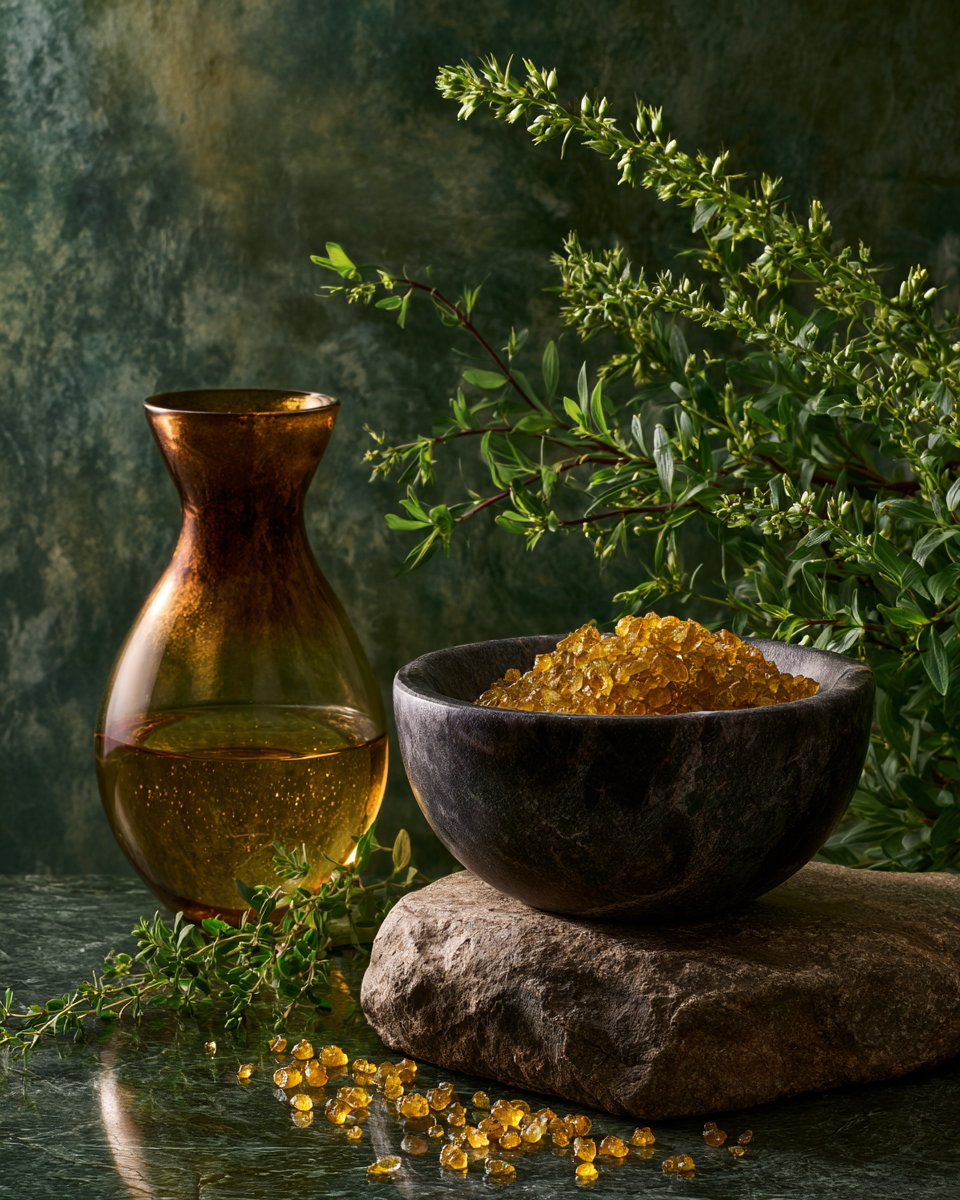
Combining Retinol and Rosehip Oil: The Method
The order is simple and waiting is key: retinol first on dry skin, wait twenty minutes, then apply the oil. Retinol stimulates cell renewal, rosehip oil nourishes and restores comfort to a challenged skin barrier.
Key takeaways
- Order: retinol, then rosehip oil.
- Waiting time: twenty minutes, non-negotiable.
- Quantities: a pea-sized amount of retinol, 2 to 3 drops of oil.
- Frequency: retinol every third night to start.
- Morning: sunscreen is mandatory.
The principle can be summarized in one sentence: an active ingredient that demands, a fatty substance that cushions. The first acts on renewal, the second provides the lipids that make the operation tolerable. By combining them, we gain duration — and duration is what produces results.
On mature skin, this combination has an additional advantage. As lipid production has decreased, the active ingredient alone costs more in terms of comfort than at thirty. The oil precisely compensates for this lack, which explains why the same concentration is better tolerated.
Adding hyaluronic acid between the two provides the aqueous phase that is missing from the overall routine. Three layers, from the most fluid to the most oily: this is the complete routine, and it doesn't require anything more.
Why oil really helps
The discomfort caused by retinol comes from a temporarily weakened skin barrier. Rosehip oil, rich in essential fatty acids, provides exactly the missing fats and limits water evaporation.
It has an additional benefit in this context: its traditional use for skin texture and marks goes in the same direction as retinol, without its drawbacks.
Evening protocol
1. Cleansing, then complete drying. Retinol should be applied to perfectly dry skin: on damp skin, it penetrates faster and irritates more.
2. Retinol. A pea-sized amount for the entire face, avoiding the eye contour area during the first few weeks.
3. Twenty minutes waiting. This is the step most often skipped, and the one that matters most.
4. Rosehip oil. Two to three drops warmed between the palms, applied with pressing motions. Focus on areas that feel tight.
The reverse method, for very reactive skin
Applying a thin layer of oil before retinol further reduces discomfort. The action is slightly attenuated, but skin that tolerates is skin that continues — and regularity takes precedence over intensity.
This is a good option for the first three weeks, to be abandoned afterward if everything goes well.
Three signs indicate that you're progressing too quickly, and they appear in this order: a persistent feeling of tightness upon waking, then fine flakes around the nose, then diffuse redness on the cheekbones. The first alone does not justify stopping; the second requires returning to the previous step for a week.
The season matters as much as the rhythm. Starting in autumn gives three months before strong sun returns, allowing the skin time to settle. Starting in May means combining the fragility of the first few weeks with maximum exposure.
For sensitive skin, the reverse order — oil first, active ingredient on top — reduces penetration and therefore discomfort. You lose intensity but gain tolerance, and for skin that has already given up once, it's a good trade-off.
Progression
Weeks 1 to 3: retinol every third night, oil after each application and on other nights.
Weeks 4 to 6: every other night if no redness persists.
After that: maintain every other night. Many skin types have no benefit in going beyond this.
Oil storage
Rosehip oil oxidizes faster than the average vegetable oil. Opaque bottle, well-sealed cap, away from heat. A rancid odor or a significantly darker color indicates oil that should no longer be applied to the face — particularly on skin already weakened by retinol.
What not to combine
Retinol and exfoliants should not be used on the same night. Alternate them. And never increase the frequency to compensate for a feeling of slowness: this is the most frequent cause of discontinuation.
Retinol is a form of vitamin A, while the oil provides fatty acids and antioxidants. This complementarity is unique: both address a different need without competing, which is rare in a routine.
For both hyperpigmentation and texture, results build slowly. Retinol promotes renewal, which improves skin texture; the oil maintains the surface during this time. Restoring radiance is not a promise of a few days but a long-term effect, also dependent on sun protection.
What not to combine: a prescribed acne treatment, glycolic acid on the same evening, or a second strong active ingredient. Combining retinol with anything other than tolerance is the most frequent source of discontinuation.
What oil specifically brings to the skin
Rosehip oil is rich in essential fatty acids, which the skin does not synthesize itself. Applied in the evening, it restores suppleness and limits water loss — two functions precisely compromised by retinol during the adaptation phase.
Two to three drops are sufficient for the face. On drier areas, an additional drop applied with a light massage improves comfort from the next day.
Once or twice a week at the beginning, this is the rhythm that allows the skin to settle. The oil, meanwhile, can be applied every evening without restriction: it requires no habituation and its role is precisely to be there when the other acts.
What is observed after three months concerns radiance and apparent firmness. Plant-based vitamin A and the oil's fatty acids promote surface maintenance; talking about boosting anything would go beyond what is established, and caution serves better here than enthusiasm.
A consistent skincare routine
On nights without retinol, the oil can be used alone after cleansing, or after a hydrating serum. In the morning, reserve the routine for gentle active ingredients and always finish with sunscreen, the most effective step in any anti-aging approach.
Three families are sufficient and complementary. Retinol works on renewal, oil provides lipids, a morning antioxidant limits what free radicals produce during the day. Each occupies a unique place; stacking more adds nothing.
What can be expected is seen on three levels: radiance returns first, then texture, then apparent firmness. These results promote the maintenance of what exists rather than rebuilding — the nuance is important when talking about aging.
A word on what not to combine. Glycolic acid on the same night as retinol, or an acne treatment prescribed by a doctor without discussing it with them: in both cases, you're adding constraints to a barrier that won't tolerate two. Revert to a rhythm of one active ingredient at a time; that's what works.
Limitations
Pregnancy and breastfeeding: retinoids should be avoided. Consult your doctor or pharmacist before resuming this active ingredient. These are cosmetics, without curative intent. Daily sun protection is part of the protocol.
What can be expected is documented and modest: a more even skin texture, less noticeable fine lines and wrinkles, a more homogeneous complexion. The first signs appear around the third month, with the main results around the sixth.
What cannot be expected: an effect on deep folds, nor an action comparable to what a prescribed treatment produces. Cosmetic retinol must be converted twice by the skin before acting, which explains both its better tolerance and its lower potency.
Regarding collagen production, the literature describes a real but slow contribution, measured in the laboratory over long periods. It is an accompaniment, not a trigger, and rosehip oil adds nothing more than the tolerance that allows one to continue.
Frequently Asked Questions
Do I really need to wait twenty minutes?
Yes. Applied too soon, the oil alters retinol penetration and can increase irritation. Twenty minutes is enough; more won't hurt.
Does oil reduce the effectiveness of retinol?
Applied afterward with the waiting time, no. Applied beforehand, it slightly attenuates the action — this is sometimes desired at the beginning of use.
Can I use oil on nights without retinol?
Yes, and it is even recommended. Oil alone on other nights maintains comfort and helps the skin tolerate reintroduction.
What if my skin peels despite the oil?
Go back to every third night for two weeks. Flaking indicates adaptation that is too rapid, not superior efficacy.
If the combination doesn't work out
When skin remains uncomfortable despite the oil, the combination isn't the problem: it's the retinol that isn't suitable. Replacing it with a bakuchiol oil serum maintains the objective while removing the constraint, and can be combined with vegetable oils without precautions.


Go further than this article
Get our skincare guides by email — and start with your free skin diagnostic: 2 minutes, advice tailored to your skin. We ship to the US, UK, Canada, Australia and 27 European countries; somewhere else? Sign up and you will be the first to know when we deliver to your country.
By signing up, you agree to our privacy policy. Unsubscribe in one click.