

Face exfoliation: frequency, technique and choosing the product
Exfoliating scrub refers to mechanical exfoliation: surface dead cells are removed by friction, using particles. It is the oldest step in facial care, and the one most often practised badly — too hard, too often, or on skin that does not need it.
Scrub, peel, exfoliation: what sets them apart
The three words are used for one another, wrongly.
The scrub acts by friction. Particles — sugar, ground kernels, silica, jojoba beads — mechanically detach surface cells. The effect is immediate and superficial.
The peel or chemical exfoliation acts by dissolution. An acid — AHA, BHA, PHA — breaks the bonds between dead cells, without rubbing. The effect is more gradual and more even.
Enzymatic exfoliation uses plant enzymes, papain or bromelain, which digest surface proteins. It is the gentlest of the three.
On reactive skin, the gentle chemical route is often better tolerated than the mechanical scrub, contrary to intuition: friction on weakened skin does more damage than a well-dosed acid.
What a scrub really brings
It smooths the skin texture in the short term, gives a more luminous look in the hours that follow, and improves the penetration of the products applied afterwards. On skin that produces a lot of sebum, it limits surface build-up.
What it does not do: it does not act on the depth of wrinkles, does not tighten pores — their diameter cannot be changed by a surface product — and does not make established blackheads disappear, as they sit too deep in the follicle.
For which skin profile
Normal skin. Once a week, fine particles, light pressure.
Oily or combination skin. This is the profile that best tolerates a mechanical scrub, once or twice a week. On combination skin, target the T-zone rather than the whole face.
Dry skin. Space it out to once every ten days, with a creamy base rather than a gel, and always nourish afterwards.
Very dry skin. A mechanical scrub is not indicated. An enzymatic exfoliation or a PHA, once a week at most, gives the same result without removing the lipids the barrier needs.
Dehydrated skin. Establish hydration first. On skin lacking water, exfoliation mostly accentuates the feeling of tightness.
Sensitive or reactive skin. To be avoided in its mechanical form. If skin texture is the subject, an enzymatic exfoliation every ten to fifteen days is enough.
Mature skin. As cell renewal slows with age, exfoliation keeps its value — but since the skin is thinner, the pressure must decrease, not increase.
Dull complexion. This is the most common indication, and often the one best served by a gentle, regular chemical exfoliation rather than by an occasional vigorous scrub.
Choosing gentle exfoliation over an aggressive scrub
Gentle exfoliation aims at the same result — removing dead cells from the surface of the skin — without the aggressive movements that weaken the skin barrier. It is the route that suits the greatest number of skin types, and the only one really suited to dry, sensitive or reactive skin.
It helps regain radiance and a more even skin texture by supporting natural cell renewal, without forcing it. Its effectiveness rests on regularity, not on intensity: a weekly gentle exfoliation gives a better result than a vigorous scrub once a month.
In practice, that means fine, round particles, light pressure, a short duration, and a moisturiser applied right after exfoliation to soothe and reduce the feeling of tightness. On skin that tolerates friction poorly, a gentle acid — PHA or lactic acid — remains the option best suited to fragile skin — that is the role of the rose water and lactic acid toner in the range.
How to proceed
On damp skin, never dry: water reduces friction. Apply with the fingertips, in very light circular movements, for thirty to sixty seconds. The pressure should be the one you would use on an eyelid.
Avoid the eye contour, the lips and any irritated area. Rinse with lukewarm water, pat dry without rubbing, and apply a moisturiser immediately.
The evening is better than the morning: the skin has the night to regain its comfort, and freshly exfoliated skin is not exposed to the sun.
The mistakes that damage
Exfoliating too often. Twice a week is a maximum for most skins. Beyond that, you maintain an irritation that you mistake for a need to exfoliate more.
Pressing. The result comes from the product, not from the force. Heavy friction leaves redness that lasts longer than the smoothing effect.
Using a body product on the face. The particles there are larger and more angular. It is the most frequent cause of micro-lesions.
Combining a scrub and an acid on the same day. Two exfoliations on the same day do not give twice the result, only twice the risk.
Exfoliating skin that is peeling. Flaking signals a barrier already under strain. Repair before exfoliating.
Recognising over-exfoliation
Persistent tightness, a burning sensation under the usual products, diffuse redness, skin becoming reactive to products previously well tolerated. These signs call for a complete break of two to three weeks, with a routine reduced to a gentle cleanser and a moisturiser.
Where it fits in the skincare routine
Exfoliation is not a daily step: it fits into the routine once or twice a week, after cleansing and before moisturising products. It is the moment when the skin best absorbs what is applied next — which is an advantage, but also the reason why a strong active is avoided on the same evening.
Choosing your face exfoliant well
Look at the nature of the particles before anything else: round and even — jojoba beads, finely ground sugar, sieved plant powders — rather than angular. Avoid coarsely crushed kernels, whose edges create micro-cuts invisible to the naked eye.
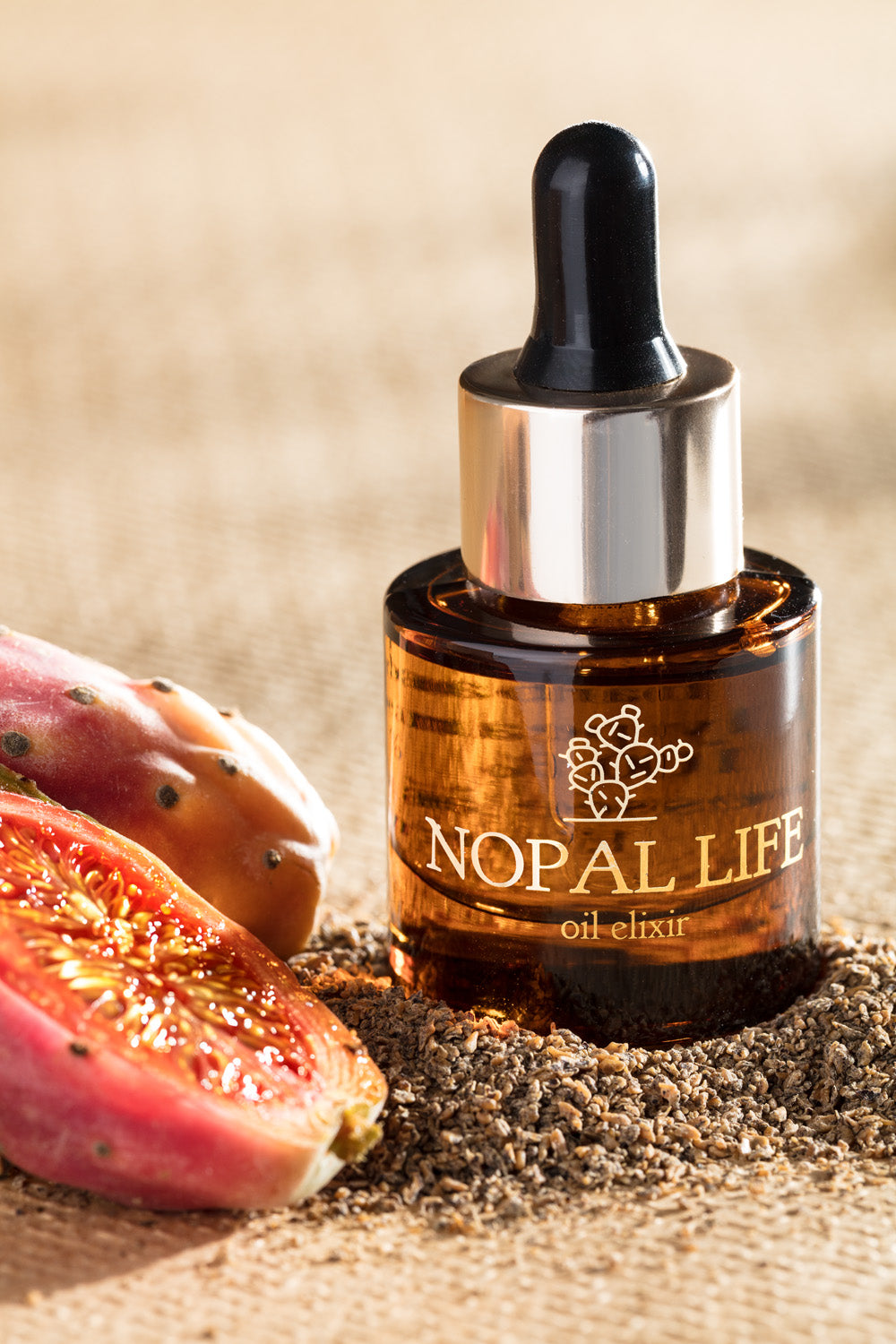
At NOPAL LIFE, the prickly pear exfoliating soap and the seed powder mask use particles from ground seeds, sieved to stay round. For a gentle chemical exfoliation, the AHA peel with lactic acid is aimed at skin that tolerates friction poorly.