Retinal: understanding this cosmetic retinoid
Retinal, or retinaldehyde, is one of the cosmetic forms of vitamin A. Less known than retinol, it nonetheless holds a special place in the retinoid family. This page explains what it is, what it isn't, and how to incorporate it into your facial routine.
Retinal, retinol, retinoids: what are we talking about?
All these terms refer to vitamin A derivatives, but they are not at the same point in the skin's conversion chain. The skin gradually transforms these molecules into their active form:
- Retinol: the most common form in cosmetics. It requires two conversion steps in the skin.
- Retinal (retinaldehyde): one step further than retinol. It requires only one conversion.
- Retinoic acid (tretinoin): the directly active form. It is prescription-only and is not included in cosmetic formulations.
- Retinoids: the generic term encompassing all these molecules, whether cosmetic or prescription.
- Vitamin A: the original family, also present in food as retinol and carotenoids.
Understanding this distinction avoids many confusions: a cosmetic retinal treatment is not a dermatological treatment and does not substitute for one.
What retinal brings to a facial treatment
In cosmetics, retinal is used for its action on the appearance of the skin: skin texture, visible uniformity of complexion, and appearance of fine lines. Reported effects depend on concentration, formulation, duration of use, and individual skin. No results are guaranteed, and visible changes generally require several weeks of consistent use.
A retinal cosmetic does not have a medical purpose. Any persistent situation—discomfort, reaction, lesion that does not disappear—requires medical advice.
Retinal cream or serum: which form to choose?
Retinal is mainly found in two forms, and the choice is primarily based on texture and tolerance.
- Retinal cream combines the active ingredient with a richer base. The enveloping texture is suitable for dry skin or those new to retinoids, as the fatty compounds in the formula often temper the sensation of discomfort.
- Retinal serum offers a more fluid texture that absorbs quickly and layers easily. It is suitable for combination skin or those who do not appreciate rich textures.
In both cases, the concentration and stability of the formula matter more than the galenic form. Retinal is a molecule sensitive to light and air: opaque and airtight packaging is a good sign of quality.
Tolerance: what to expect
Cosmetic retinoids are known to require an adjustment period. The most common manifestations at the beginning of use are tightness, a sensation of dryness, fine flaking, or temporary redness. These generally diminish as the skin gets used to it.
Some precautions:
- Start with two applications per week, in the evening, then gradually increase if the skin remains comfortable.
- Apply a small amount to perfectly dry skin, avoiding the immediate eye area, sides of the nose, and corners of the lips.
- Reinforce hydration in parallel with a well-tolerated cream or vegetable oil.
- Protect your skin from the sun: retinoids make the skin more sensitive to sun exposure. Daily sun protection is essential throughout the entire period of use. See how to choose your SPF.
- Discontinue use in case of significant discomfort that does not subside, and seek advice from a healthcare professional.
Pregnancy and breastfeeding: as a precaution, the use of vitamin A derivatives is not recommended. It is advisable to seek medical advice before any use.
Combining retinal with other active ingredients
The question of combinations comes up constantly. A few simple principles are enough to avoid the most frequent mistakes:
- Hyaluronic acid: comfortable combination. Hyaluronic acid provides water to the superficial layer and compensates for the sensation of dryness.
- Ceramides and squalane: complementary. Ceramides and vegetal squalane support the skin barrier during the adaptation phase.
- Niacinamide: well-tolerated in combination, often applied before retinal.
- Acid exfoliants (AHA, BHA): do not layer on the same evening. Alternating evenings limits discomfort.
- Vitamin C: preferably in the morning, retinal in the evening. Layering them does not add anything and increases the risk of irritation.
The most common mistakes
- Starting every evening from the first week.
- Increasing the quantity hoping to speed up results: tolerance decreases, not the other way around.
- Giving up after ten days, before the skin has had time to adapt.
- Neglecting sun protection.
- Combining retinal, scrubs, and exfoliating acids in the same routine.
A plant-based alternative: bakuchiol
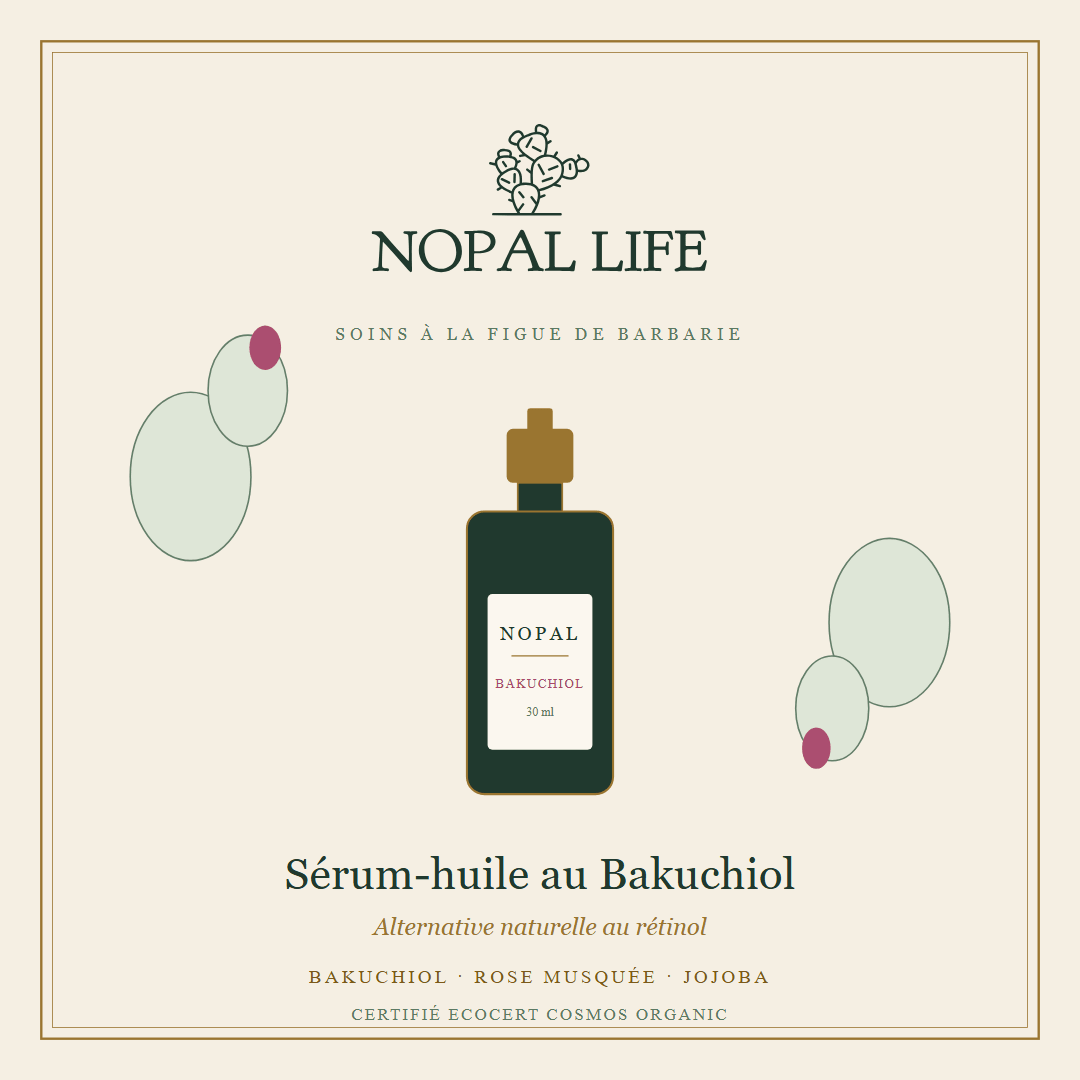
Reactive skin, or those who prefer to avoid vitamin A derivatives, often turn to bakuchiol, a plant-derived active ingredient known for its better tolerance. The two molecules do not have the same structure or mode of action, but bakuchiol is frequently chosen by those looking for a gentler approach. See also how to use bakuchiol and the comparison bakuchiol or niacinamide.
At NOPAL LIFE, our formulas are based on plant-based active ingredients, first and foremost prickly pear oil. Our products do not contain retinal: this page is for informational purposes.
Frequently Asked Questions
Is retinal stronger than retinol?
It is one step further in the conversion chain, which explains why, at comparable concentrations, it is often described as more rapidly active. "Stronger" does not mean "better": individual tolerance remains the determining criterion.
At what age should I start?
There is no fixed age. The approach depends on the condition of the skin and individual expectations. See our guide on anti-aging routine by age.
Can retinal be used around the eyes?
The skin there is particularly thin. It is best to stick to products formulated for this area: see how to apply eye contour care.
How long before I see a difference?
User feedback generally suggests several weeks of regularity. No specific timeline can be guaranteed.
To go further
Find the fundamentals in the Skin Academy, the role of hydration in a daily routine, and our approach to wrinkles and their appearance. To identify what suits your skin, the SKIN INTELLIGENCE path guides you step-by-step.
For more details on this specific point, see our guide Retinal or retinol.
What the plant-based alternative concretely changes
Retinal works faster than retinol because it has one less conversion step to make—and that's also why it's less well tolerated. Bakuchiol does not belong to this family and does not claim the same results; a bakuchiol oil serum simply avoids the retinization phase.
Our anti-aging treatments