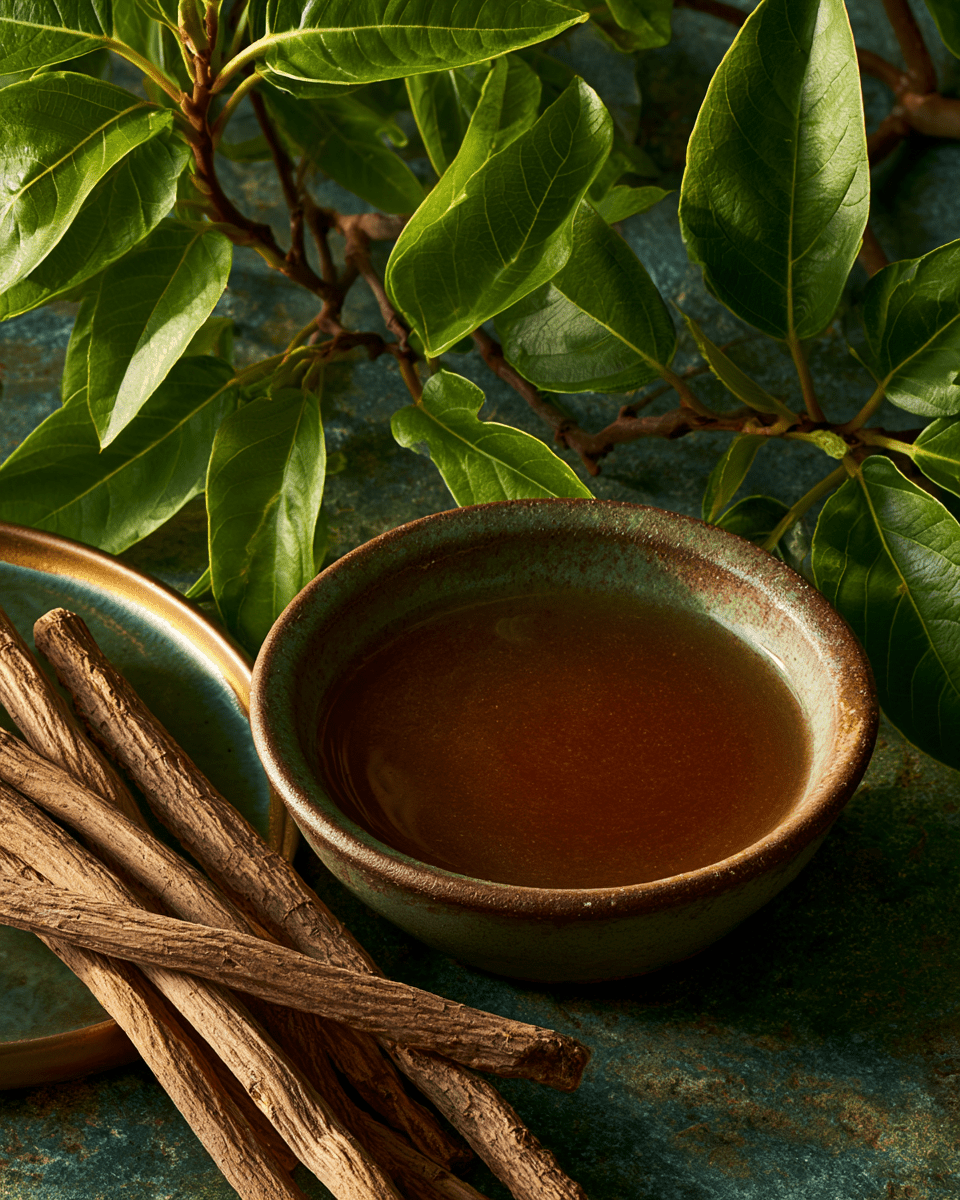
Licorice: natural skincare benefits and routine P1
Behind every beautiful ingredient lies a botanical story and specific uses. This guide dedicated to Licorice gives you the essentials: what it is, for which skin types, how to use it — and what to pair it with in a NOPAL LIFE routine.
Glycyrrhizin, the star molecule of licorice in skin care
Licorice root (Glycyrrhiza glabra) has been used for over 4,000 years in Chinese and Ayurvedic traditions. Its key component, glycyrrhizin, is a triterpenoid whose concentration varies between 2% and 25% depending on the quality of the extract. Licorice also contains liquiritin, a flavonoid traditionally valued for helping to unify skin tone appearance, and isoliquiritin, whose antioxidant action helps protect the skin against oxidative stress. UV rays generate a large portion of free radicals on the surface, making licorice a prime ingredient in antioxidant skincare formulas. For sensitive skin prone to redness and discomfort, licorice extract is a particularly well-tolerated natural alternative.
Soothing properties
Licorice is traditionally recognized for helping to soothe the appearance of redness and discomfort in reactive skin. In topical formulas, the recommended concentration is between 0.5% and 2% of standardized extract. This gentleness is enhanced by the presence of stearyl glycyrrhetinate, a lipophilic ester particularly suitable for rich emulsions intended for very reactive skin. With regular use, licorice helps to comfort easily reactive skin, unify skin tone appearance, and soothe the appearance of diffuse redness. It is well-tolerated by sensitive skin, even around the periocular and nasal areas, where aggressive active ingredients are not recommended.
Action on skin tone appearance: a popular unifying active ingredient
Liquiritin and isoliquiritin, the two main flavonoids in licorice, are valued for gently promoting an even skin tone. They help reduce the appearance of existing spots and maintain a more homogeneous complexion, while comforting the skin against discomforts that accentuate marks after a blemish. This gentleness makes licorice a choice active ingredient in inclusive radiance routines, suitable for all phototypes, including darker ones (phototypes IV to VI), which often react unfavorably to aggressive active ingredients. With a 2% licorice extract over 12 weeks, a visible reduction in the appearance of sun spots and other marks is observed, with an excellent tolerance profile. Licorice combines well with vitamin C, low-dose retinol, and niacinamide in multi-active radiance formulas for sensitive skin or those intolerant to aggressive treatments.
Mistakes to avoid with licorice in your beauty routine
Despite its excellent tolerance profile, certain usage errors can limit the effectiveness of licorice-based products. The first mistake is choosing non-standardized extracts: the glycyrrhizin content must be specified on the packaging or technical sheet. A vague extract simply labeled "licorice root extract" without any specified content offers uncertain benefits. The second mistake is expecting immediate results: the visible benefits of licorice gradually appear over 8 to 12 weeks. Stopping the treatment after 3 weeks is premature. Thirdly, not combining licorice with daily sun protection greatly reduces its impact on skin tone appearance: without a minimum SPF 30, the appearance of spots can return as quickly as it fades. Fourthly, overdosing is counterproductive: beyond 3% glycyrrhizin in a finished formula, no additional benefit is observed, and the risk of discomfort on very reactive skin increases. Fifthly, avoid combining licorice with aggressive chemical exfoliants (AHAs over 10%, retinol over 0.5%) without an acclimatization period: the risk of cumulative discomfort is real even if each active ingredient taken individually is well-tolerated.
Integrating licorice into a daily radiance routine
Licorice is ideally integrated into a morning and evening routine, in a serum or day cream. In the evening, its soothing properties support the skin's nocturnal rest. In the morning, its antioxidant action prepares the skin for the aggressions of the day. A typical routine for sensitive skin with an uneven complexion is structured as follows: gentle cleansing with micellar water or cream gel, soothing alcohol-free toner, licorice serum (0.5% to 2% glycyrrhizin), light hydrating day cream, and SPF 50 sun protection. Integrating licorice from 25-30 years old is a relevant preventive measure. In the evening, the licorice serum can be followed by a richer night cream based on vegetable oil, such as prickly pear oil, whose omega-6 and vitamin E reinforce the soothing effect. As a 4-week treatment, licorice can be used morning and evening without interruption, then switched to daily maintenance application. Very sensitive skin types should start with application every other day to assess individual skin tolerance.
The Nopal Life approach: licorice and prickly pear oil in synergy
At Nopal Life, the skincare philosophy is based on the complementarity of natural active ingredients to soothe the skin without aggressing it. The combination of licorice and prickly pear oil perfectly illustrates this approach: licorice helps to soothe the appearance of redness and unify the complexion, while prickly pear oil (Opuntia ficus-indica) strengthens the lipid barrier and provides hydration thanks to its essential fatty acids (omega-6, tocopherols, plant sterols). Together, these two active ingredients cover all the needs of sensitive and pigment-prone skin: soothing, comfort, antioxidant protection, and gentle support for the appearance of spots. For combination to oily skin with marks after imperfections, the combination of licorice + niacinamide + prickly pear oil as a finish creates a synergy: mattified shiny areas, refined pore appearance, and reduced appearance of spots. For mature and dry skin, licorice combined with prickly pear oil in a night balm offers comfort and radiance without weighing down the complexion. Our free skin diagnosis guides you to the most suitable combination of active ingredients for your skin profile.
Frequently asked questions
Q: Is licorice suitable for black and mixed-race skin?
A: Yes, this is one of its major assets. Unlike some aggressive active ingredients, licorice supports the appearance of the complexion gradually and uniformly over the entire surface, without harshness.
Q: How long does it take to see the appearance of spots fade?
A: The first visible results generally appear between 6 and 8 weeks of regular use with daily sun protection. The optimal effect is observed at 12 weeks.
Q: Can licorice irritate the eyes?
A: Topical formulas based on licorice are generally well-tolerated in the periocular area at concentrations ≤ 2%. Avoid direct contact with ocular mucous membranes and rinse thoroughly with clear water in case of accidental contact.
Q: What is the difference between licorice and kojic acid for spots?
A: Kojic acid acts faster in the short term but can be more irritating and unstable in formulation. Licorice offers a gentler, more gradual, and better-tolerated action, ideal for reactive skin or long-term use.
Q: Is licorice compatible with vitamin C skincare?
A: Yes, these two antioxidant active ingredients are complementary for skin tone appearance. First, apply the vitamin C serum (acidic pH), let it absorb for 2 minutes, then apply the licorice treatment.
Q: Can licorice be used all year round, even in summer?
A: Absolutely, and it is even recommended in summer when UV rays accentuate the appearance of spots. The combination of licorice + SPF 50 is the most effective radiance routine during periods of sun exposure.
Q: Are there any known precautions for topical licorice?
A: Precautions are rare. Sensitivity to plants from the Fabaceae family (legumes) may be a risk factor. In case of a history of sensitivity to soy, peanuts, or peas, a patch test on a small area is recommended before applying to the face.
Our star oil
Nopal Life pure prickly pear oil: rich in omega-6 and vitamin E for soothed and luminous skin.
Discover the oilFree diagnosis
Find the personalized routine adapted to your skin type in less than 3 minutes.
Take the diagnosisRead more
This content is for informational and educational purposes only; it does not replace medical advice, diagnosis, or dermatological consultation. In case of doubt or persistent skin problems, consult a qualified health professional.


Go further than this article
Get our skincare guides by email — and start with your free skin diagnostic: 2 minutes, advice tailored to your skin. We ship to the US, UK, Canada, Australia and 27 European countries; somewhere else? Sign up and you will be the first to know when we deliver to your country.
By signing up, you agree to our privacy policy. Unsubscribe in one click.