Prickly pear polyphenols: betalains, flavonoids, and vitamin C
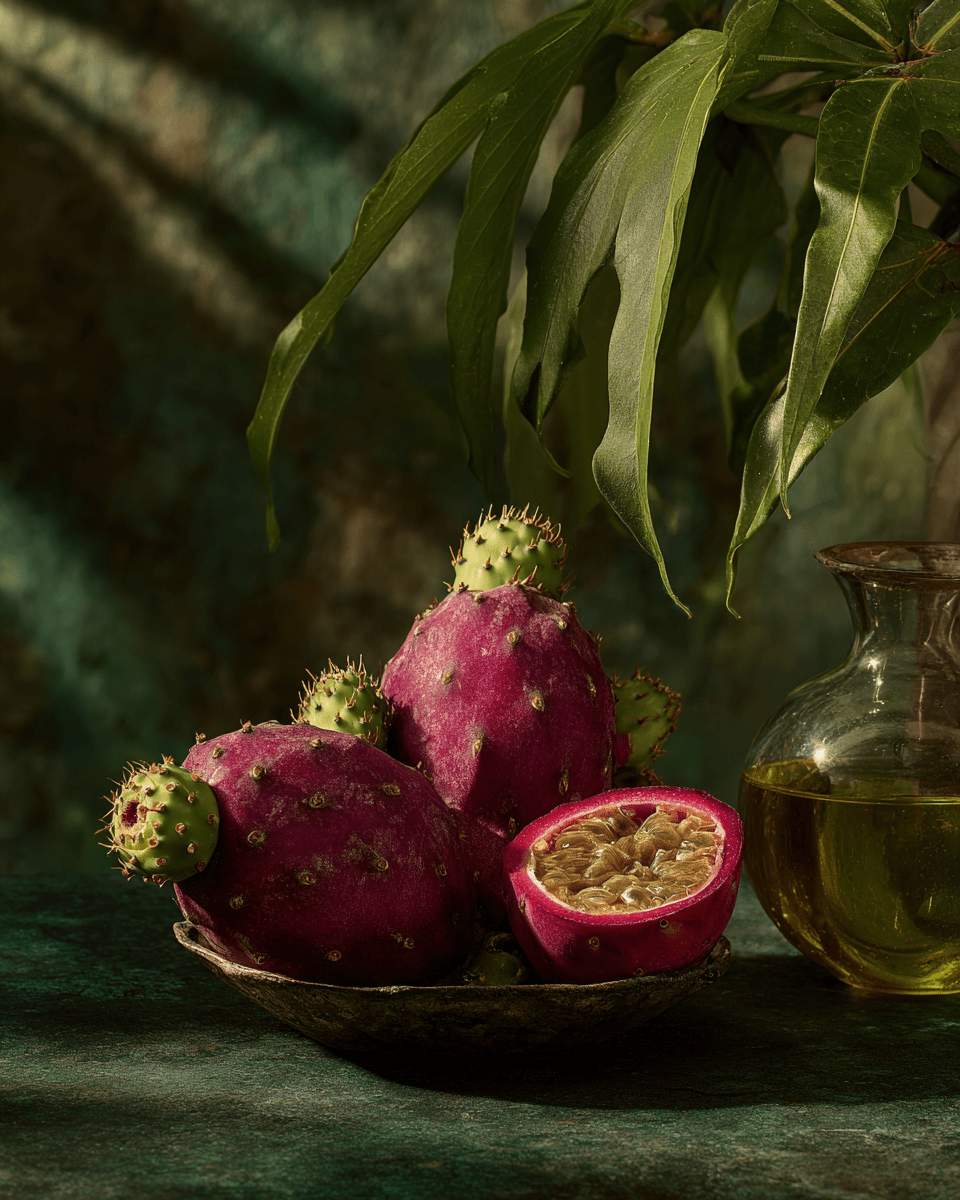
Prickly pear (Opuntia ficus-indica) is much more than a desert fruit. Its cladodes, flowers, and seeds contain an exceptional concentration of polyphenols—bioactive molecules recognized for their cosmetic benefits in terms of skin comfort and radiance. In a context where consumers are looking for natural-formula skincare, prickly pear polyphenols stand out as a leading active ingredient for dehydrated and sensitive skin. This article guides you through their properties, their synergy with other molecules from the plant, and their integration into an adapted cleansing routine.
1. What are polyphenols and why is prickly pear so rich in them?
Polyphenols are secondary phytochemical compounds produced by plants as a defense mechanism against oxidative stress, UV rays, and unwanted microorganisms. They are classified into several families: flavonoids, phenolic acids, stilbenes, and tannins. Opuntia ficus-indica synthesizes polyphenols in large quantities precisely because it thrives in extreme environments—intense solar radiation, prolonged drought, and significant temperature fluctuations.
Phytochemical analyses reveal that prickly pear primarily contains:
- Betalains (betacyanins and betaxanthins): water-soluble pigments exclusive to Caryophyllales, prized for their antioxidant power;
- Flavonoids (kaempferol, quercetin, isorhamnetin): molecules associated with the firm and plump appearance of the skin;
- Ascorbic acid (vitamin C): an ingredient recognized for promoting skin radiance and a luminous appearance;
- Phenolic acids (gallic acid, p-coumaric acid): compounds valued for the comfort of sensitive skin.
This synergistic combination is rarely found in such concentration in a single natural ingredient, which explains the growing interest of natural cosmetic formulators in Opuntia extract.
2. Betalains, flavonoids, and ascorbic acid: the triple antioxidant richness
Understanding the benefits of prickly pear polyphenols requires looking at how these three molecular families complement each other.
Betalains are plant-based antioxidants valued for helping to protect the skin from external aggressions such as UV rays and atmospheric pollution. They thus contribute to the comfort of skin exposed daily and help maintain a healthy and radiant skin appearance.
Flavonoids (quercetin, kaempferol) play a complementary role: they are valued for helping to soothe the appearance of sensitive skin and reduce the visible appearance of redness, while also helping to maintain the skin's firm and plump appearance.
Finally, ascorbic acid completes the picture: it is one of the recognized ingredients for supporting complexion radiance and maintaining the skin's firm and toned appearance. This richness explains why Opuntia polyphenol-standardized extracts are so highly valued in natural cosmetics.
3. Prickly pear polyphenols and skin barrier: support for comfort
The skin barrier—this assembly of corneocytes and intercellular lipids (ceramides, free fatty acids, structural lipids)—is the primary defense against dehydration and external aggressions. In dehydrated and sensitive skin, this barrier can appear weakened: sensation of discomfort, tightness, increased reactivity.
Prickly pear polyphenols offer several advantages for this skin type:
- Smooth and uniform appearance: flavonoids support the skin's natural renewal, for a visibly clearer skin texture;
- Comfort and suppleness: by helping to protect the skin from oxidative stress, they contribute to maintaining a supple and comfortable appearance;
- Visible soothing: they are valued for helping to soothe the appearance of reactive skin and reduce the visible appearance of redness.
These assets make Opuntia extract a particularly relevant active ingredient for the comfort of weakened skin and the preservation of its natural radiance.
To fully benefit from these advantages for skin comfort, the Nopal Life prickly pear regenerating cream formulates Opuntia extract in association with complementary active ingredients that support its action. Also discover our Nopal Life Skin Intelligence™ tool to identify the protocol best suited to your skin profile.
4. Incorporating polyphenols into a cleansing routine for dehydrated and sensitive skin
The cleansing step is often underestimated in routines for sensitive skin. However, an unsuitable cleanser (too detergent, too alkaline pH, enriched with alcohol) can by itself remove natural intercellular lipids and accentuate the sensation of tightness. This is precisely where prickly pear polyphenols play an essential preventive role.
Here's how to structure a Hydration & Comfort routine around the cleansing step:
- Morning: rinse with lukewarm water (avoid hot water which dissolves skin lipids) or gentle cleansing with micellar water enriched with polyphenols. Then apply a light moisturizing protection containing Opuntia extract;
- Evening: double cleansing in case of makeup or pollution—first step vegetable oil (ideally prickly pear oil to benefit from essential fatty acids), second step gentle cleanser adapted to skin pH (4.5–5.5). Finish with the prickly pear regenerating cream applied to still slightly damp skin to help preserve hydration;
- Weekly: gentle enzymatic exfoliation (1 to 2 times a week) to help remove dead surface cells without mechanical aggression—to be integrated into the evening cleansing step before applying the active treatment.
This structure ensures that polyphenols can act on a clean skin surface, without competition from product residues or impurities that would reduce their effectiveness.
For more on building a complete hydration routine, consult our dedicated guide. You can also explore our page on the benefits of prickly pear oil, which ideally complements the action of polyphenols. Our article on the skin barrier also deepens the concepts discussed here.
5. Mistakes to avoid with Opuntia polyphenol skincare
The effectiveness of prickly pear polyphenols relies on precise usage conditions. Several common mistakes significantly reduce their benefits:
- Combining with strong oxidizers: some very low pH AHAs can degrade betalains and flavonoids, diminishing their antioxidant benefits;
- Applying to dry skin after aggressive cleansing: if cleansing has weakened the hydrolipidic film, polyphenols are less well tolerated and can promote a sensation of discomfort;
- Storing in direct light: betalains are photosensitive—a serum or cream exposed to UV light will see its active ingredients degrade rapidly. Prefer opaque or amber glass bottles;
- Expecting immediate results on complexion: polyphenols help to unify the appearance of the complexion, but their visible unifying effect requires 4 to 8 weeks of regular application;
- Ignoring the synergy with niacinamide: niacinamide (vitamin B3) and Opuntia polyphenols act complementarily for skin comfort. Combining them in a routine maximizes the felt effect. However, high-concentration pure vitamin C can compete with some polyphenols—dose sparingly.
6. How to choose a skincare product formulated with prickly pear polyphenols?
Not all products claiming prickly pear contain polyphenol-standardized extracts. Here are the selection criteria:
- Position in the INCI list: Opuntia extract (INCI: Opuntia ficus-indica fruit extract or Opuntia ficus-indica stem extract) must appear within the first 10 ingredients to guarantee an active concentration;
- Standardization in betalains and flavonoids: a reputable supplier provides a Certificate of Analysis (CoA) mentioning the total polyphenol content (Folin-Ciocalteu method);
- Formulation pH: a pH between 4.5 and 6 preserves the stability of polyphenols and their compatibility with the skin microbiome;
- Absence of aggressive chelating agents (EDTA in high quantity) which can alter the quality of the formula.
The Nopal Life prickly pear regenerating cream meets all these criteria: Opuntia extract at the top of the formula, controlled pH, formulation without endocrine disruptors. Test your skin profile on our Nopal Life Skin Intelligence™ tool to confirm that this treatment matches your profile.
FAQ — Prickly pear polyphenols and skincare
- Are prickly pear polyphenols suitable for oily skin?
- Yes. Their action, appreciated for helping to mattify the appearance of shiny areas, makes them relevant for all skin types, including combination to oily skin. However, the texture of the product (rich cream vs. gel-cream) must be adapted to the desired comfort.
- What's the difference between prickly pear polyphenols and classic antioxidants (vitamin C, vitamin E)?
- Vitamin C and vitamin E are single-target antioxidants. Opuntia polyphenols offer multi-faceted richness: appreciated action on the appearance of skin exposed to aggressions (betalains), comfort for sensitive skin (flavonoids), and radiance support (ascorbic acid). This molecular diversity makes it a broader-spectrum active ingredient.
- How long does it take to see the first effects on skin comfort?
- The appearance and sensation of comfort generally improve noticeably within 4 weeks of daily application of a properly formulated product. The visible effect on comfort and reduction of tightness is often perceived as early as the 2nd week.
- Can Opuntia polyphenols replace sunscreen?
- No. Despite their appreciated antioxidant benefits, polyphenols help preserve the appearance of skin after exposure, but do not block UV rays. They are a valuable complement to sun photoprotection (SPF 30 or higher), not a substitute.
- Is prickly pear extract stable in cosmetic formulations?
- Betalains are sensitive to heat and light. Modern formulations use encapsulation techniques (liposomes, niosomes) or work at low processing temperatures to preserve the activity of polyphenols. Always check the recommended storage conditions on the packaging.
- Can prickly pear polyphenol skincare be combined with retinol?
- Yes, and this combination is particularly interesting: retinol supports the skin's natural renewal (transiently increasing sensitivity), while Opuntia polyphenols help preserve comfort and reduce the visible appearance of redness associated with retinoids. Apply retinol first, let absorb for 20 minutes, then apply the polyphenol product.
- Where can I buy quality prickly pear polyphenol skincare?
- Prioritize brands that are transparent about their formulations (complete INCI list, origin of extract, polyphenol content). The Nopal Life prickly pear regenerating cream is formulated with a traceable Opuntia extract, without controversial ingredients. Take our Nopal Life Skin Intelligence™ diagnostic to confirm that this product matches your profile.
To learn more:
— The antioxidant properties of prickly pear (Opuntia ficus-indica) extracts are generating increasing interest in natural cosmetics.
— The plant's richness in betalains, flavonoids, and phenolic acids is widely documented in botanical literature.
Why build your face routine with Nopal Life
An effective skincare routine isn't just a stack of products: it's a sequence of complementary active ingredients applied in the right order, on clean skin, for visible and lasting results. Nopal Life has designed each product to work just as well alone as in synergy with the other products in the range. Prickly pear oil is the common thread: present in several formulas, it ensures consistency and tolerance for all skin types.
Start with our free Skin Intelligence diagnostic. In 3 minutes, it identifies your skin type, your primary concerns, and suggests a personalized routine from our 6 skincare rituals.
PERSONALIZED ROUTINE
Nopal Life Skin Intelligence™
Free diagnostic · 2 minutes
DISCOVER MY ROUTINE →Read more
Information provided for cosmetic and educational purposes only; it does not constitute medical advice.


Go further than this article
Get our skincare guides by email — and start with your free skin diagnostic: 2 minutes, advice tailored to your skin. We ship to the US, UK, Canada, Australia and 27 European countries; somewhere else? Sign up and you will be the first to know when we deliver to your country.
By signing up, you agree to our privacy policy. Unsubscribe in one click.