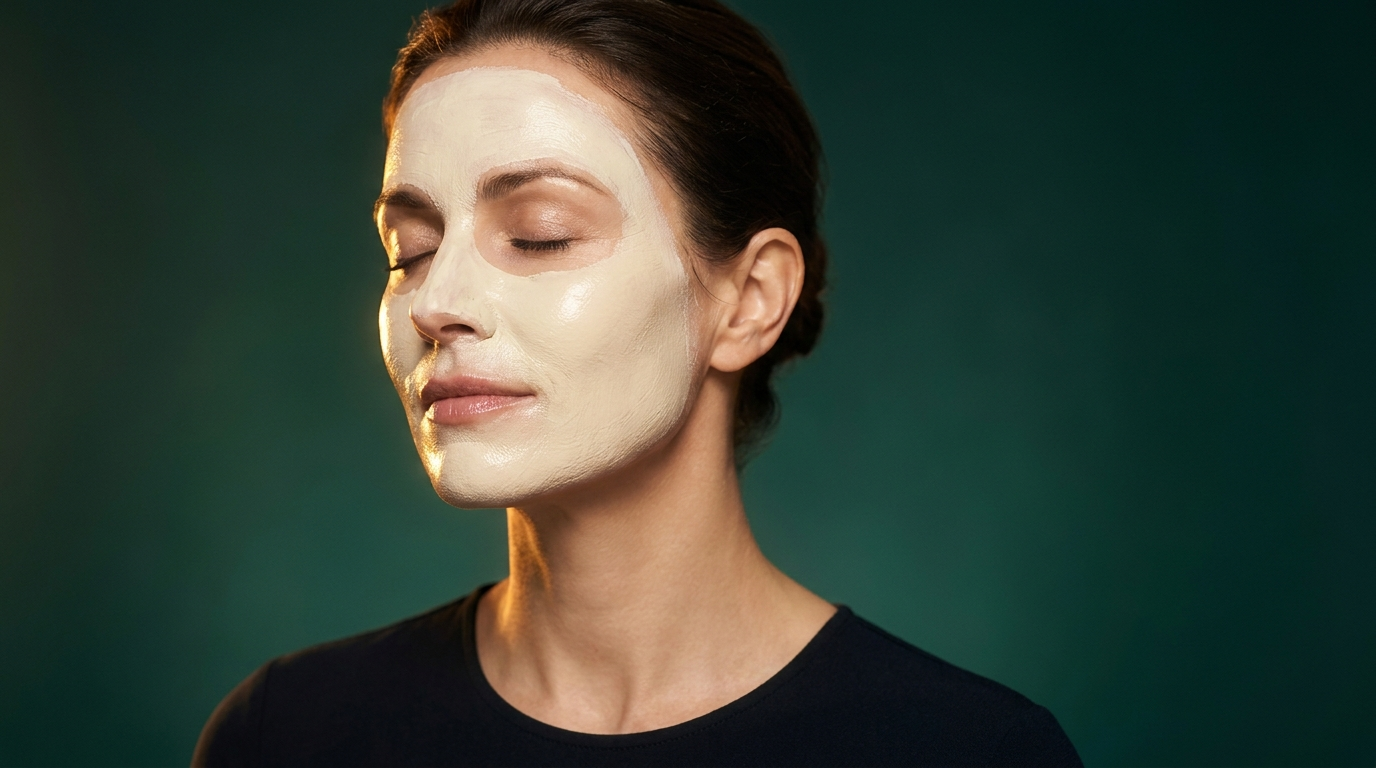
Women's face masks: choosing according to skin condition
There is no such thing as a "women's mask": there are masks adapted to a skin type and its daily condition. Oily skin at twenty-five and dry skin at fifty-five do not require the same texture, but age alone does not dictate everything — two women of the same age may need opposite masks. This page offers a selection method based on observable facts, not demographic categories.
Distinguishing skin type from its daily condition
This distinction prevents most purchasing errors.
Type is a stable, largely genetic tendency: dry, normal, combination, or oily. It evolves slowly, over years, due to age and hormonal variations.
Condition is temporary and overlays the type: dehydration, sensitivity, dull complexion, discomfort. Oily skin can be dehydrated, dry skin can be sensitive, and these combinations are frequent.
Choosing a mask based solely on type ignores half the information. Dehydrated oily skin treated as simply oily skin — clay, mattifiers, drying formulas — worsens with each application. See the module understanding your skin type.
The three-minute test
It reveals the actual daily condition, which should guide your choice.
Cleanse your face with lukewarm water, pat dry, then apply nothing for three minutes. Then observe your cheeks, forehead, and nose separately.
| What you observe | What it indicates | Recommended mask |
|---|---|---|
| Tightness on the cheeks | lack of lipids or water | cream or nourishing mask |
| Shine only on the T-zone | combination skin | targeted clay, hydrating elsewhere |
| Generalized shine | oily skin | green clay or kaolin |
| Diffuse redness, sensation of warmth | temporary reactivity | soothing gel with oat or aloe vera |
| Dull complexion without discomfort | slowed desquamation | radiance mask, gentle exfoliation |
| Fine lines on the cheeks | surface dehydration | hyaluronic acid mask |
Do not retain more than three signs. Beyond that, you choose a mask that claims to do everything and does nothing correctly.
What hormonal variations actually change
This is the only place where the question of gender has a physiological answer.
During the menstrual cycle, sebum production follows progesterone variations: it increases in the days leading up to menstruation, which explains the shine and imperfections during this period. Skin is also more reactive in the premenstrual phase.
During pregnancy, vascular reactivity increases, and the mask of pregnancy can appear. Caution applies to active ingredients: retinoids are not recommended, and any introduction should be discussed with a healthcare professional.
At menopause, the drop in estrogen significantly reduces sebum production and dermal density. Skin that was oily all its life can become dry in a few years. This is the most marked change, and the one that surprises the most.
Practical consequence: the mask that suited you five years ago may no longer be suitable. Re-doing the three-minute test once or twice a year is better than repurchasing out of habit.
Choosing the texture
The format matters as much as the active ingredients, because it determines whether the mask will actually be used.
Cream masks are suitable for dry and mature skin. They nourish, do not dry on the skin, and can be removed with cotton or rinsed off depending on the formula.
Clay masks absorb sebum. Green for oily skin, white for more sensitive skin, pink as a compromise. They must be rinsed off before complete drying: clay that cracks draws water from the skin instead of absorbing sebum.
Sheet masks deliver a serum under occlusion for fifteen minutes. Convenient, no rinsing, but single-use and not very suitable for very dry skin that requires emollients.
Gel masks hydrate and refresh without emollients. This is the format for dehydrated oily skin, a common and poorly served case.
Overnight masks are applied in a thin layer and are not rinsed off. They are suitable for dry skin and periods of skin fatigue.
A hydrating cream or gel mask is suitable for tight-feeling skin; a purifying clay mask for shiny areas. This is the only criterion that truly matters, and it is judged on the daily condition rather than the skin type.
Leave on for the indicated time, never longer: a clay mask that dries completely removes more than it provides. The eye contour remains outside the application, unless the product is specifically designed for this area.
By age group, with a caveat
Age guides without dictating. These guidelines are valid in the absence of contradictory signs in the three-minute test.
Before thirty, needs revolve around imperfections and shine. Targeted clay on the T-zone once a week, hydrating elsewhere. Anti-aging masks offer no benefit at this age.
From thirty to forty-five, sebum production gradually decreases and the first dehydration fine lines appear. Hydrating masks with hyaluronic acid, gentle exfoliation once a week.
After fifty, the skin becomes thinner, drier, and less dense. Rich cream masks with emollients and ceramides, twice a week if necessary. See our mature skin routine.
The caveat is important: a fifty-five-year-old woman with oily skin exists, and recommending a rich mask solely based on her age is a mistake.
Frequency and place in the routine
- Once or twice a week is sufficient. Beyond that, the skin barrier is weakened regardless of the mask.
- In the evening, after cleansing, on clean, dry skin.
- After complete makeup removal. A mask applied over residue works on the residue.
- Before serum and cream, never after: the mask paves the way, the routine seals.
- Never on the same evening as an exfoliation or an exfoliating active ingredient. Space them out by at least three days.
For combination skin, zone-specific application yields much better results than a single mask: clay on the forehead, nose, and chin, hydrating on the cheeks. This is the main advantage of a thoughtful routine over a single product.
What a mask does not do
It does not correct an unsuitable routine. Fifteen minutes a week do not compensate for aggressive cleansing, lack of hydration, or lack of sun protection.
It does not tighten pores. Their diameter is genetically determined; a cleared pore appears smaller, the anatomy does not change.
It does not act on established wrinkles. It improves surface appearance and comfort, which reduces dehydration fine lines — a real effect, distinct from an action on the dermis.
And no mask is suitable "for women" as such. What matters is skin type, its daily condition, and the stage of the life cycle — three pieces of information that the three-minute test provides for free. See also our page choosing your routine.


Go further than this article
Get our skincare guides by email — and start with your free skin diagnostic: 2 minutes, advice tailored to your skin. We ship to the US, UK, Canada, Australia and 27 European countries; somewhere else? Sign up and you will be the first to know when we deliver to your country.
By signing up, you agree to our privacy policy. Unsubscribe in one click.