Prickly pear oil or rose water: which to choose?
These two natural products do not occupy the same place or the same phase. Rose water is a floral water: it soothes, refreshes, and prepares the skin. Prickly pear seed oil is a rich fatty substance that nourishes and seals at the end of the routine. One opens, the other closes.
Two distinct roles
| Criterion | Prickly Pear Seed Oil | Rose Water |
|---|---|---|
| Nature | vegetable oil | floral water, hydrosol |
| Phase | oily | aqueous |
| Place | last step | first step, after cleansing |
| Action | nourishes, retains water | soothes, refreshes, tones |
| Price | very high | moderate |
| Quantity | 2 to 3 drops | a few sprays |
What rose water provides
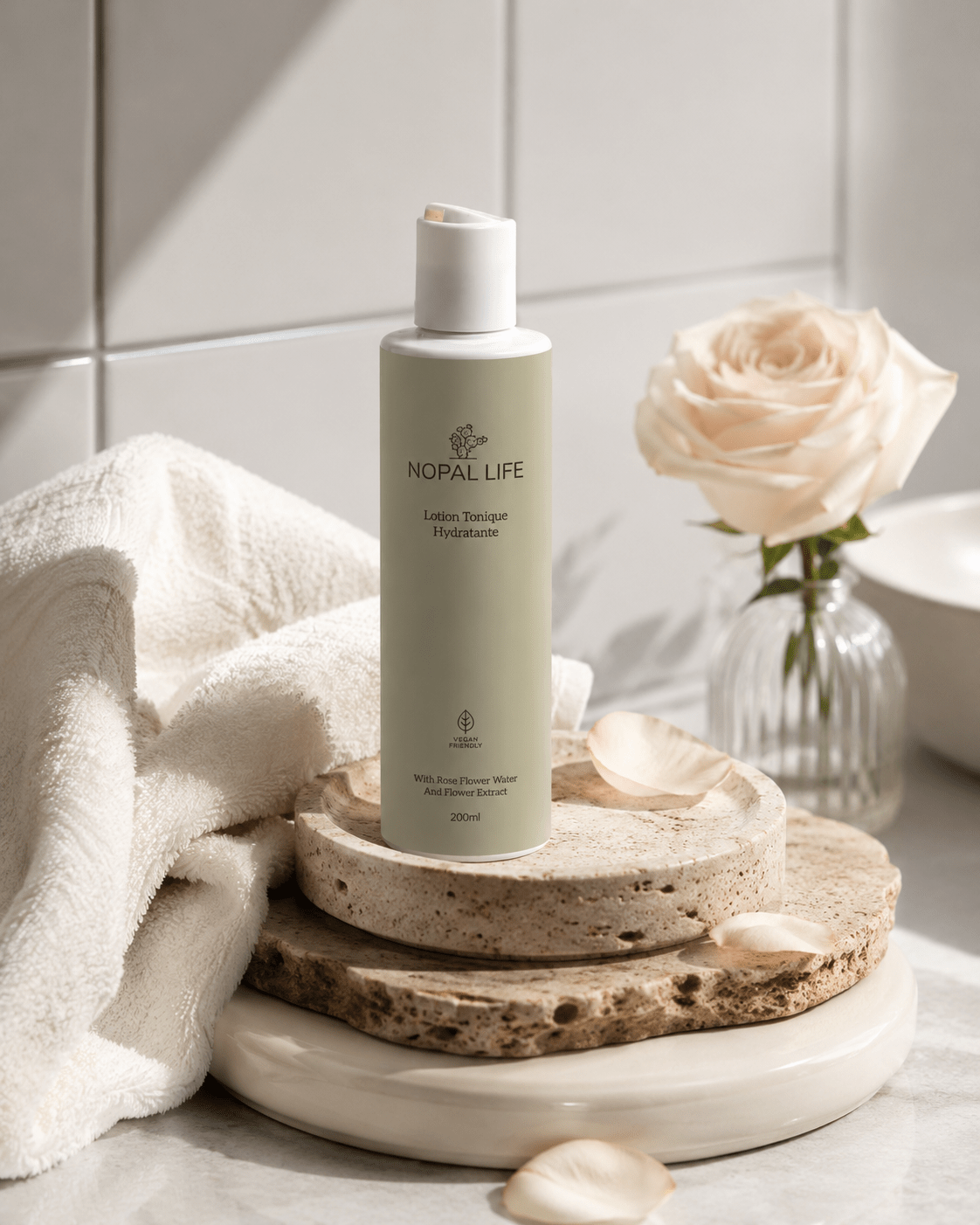
Obtained by distilling petals, it is a water loaded with aromatic compounds in very low concentration. Its action is gentle: it soothes heating sensations, refreshes, and leaves the skin slightly moist.
This last point is the most important. A floral water applied before subsequent treatments significantly improves their effectiveness because a fatty substance applied to damp skin retains much more moisture.
What prickly pear seed oil provides
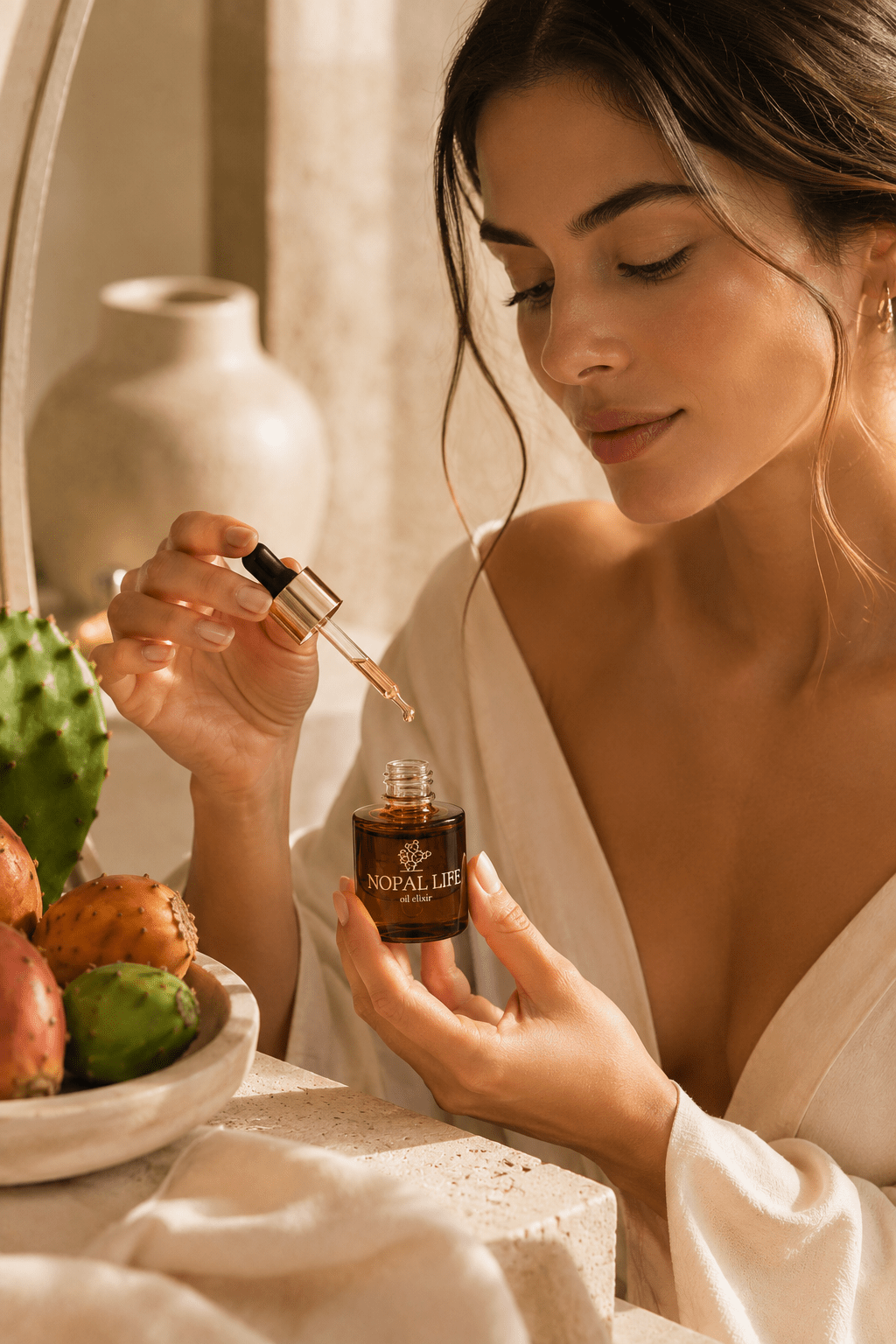
Prickly pear seed oil is extracted from the seeds of the fruit of Opuntia ficus indica. Its richness in linoleic acid and tocopherols gives it nourishing properties and an antioxidant action against surface skin aging.
Its texture is fine and penetrates quickly, which is rare for such a concentrated oil. This quality makes it a facial treatment suitable even for skin types that usually refuse fatty substances.
Its rarity is structural: one liter requires nearly a ton of prickly pears. At NOPAL LIFE, the fruits come from family farms in the arid highlands of eastern Algeria and Kabylia.
The difference lies in the phase: rose water is aqueous, prickly pear oil is lipidic. The first provides water that nothing retains; the second contains not a drop of water but prevents the water that is there from leaving.
That's why the question "which to choose" is ill-posed. On tight skin, applying rose water alone gives nothing lasting, and oil alone on dehydrated skin seals in a deficiency. The skin type determines the proportions, not the order — which always remains the same: aqueous first, then oily.
What the oil bottle contains can be summarized in a few lines: essential fatty acids that the body does not synthesize, and tocopherols that slow down the action of free radicals. On the label, look for "prickly pear seed oil" accompanied by "cold-pressed" — without it, the stated liter value is meaningless.
Which one to choose
The question is ill-posed, as they do not replace each other. A floral water alone nourishes nothing; an oil alone, on dry skin, seals a surface that has nothing to retain.
If you had to keep only one: prickly pear seed oil, because it provides a substance that the skin does not produce. Rose water is a comfort, not a contribution.
Using them together, which is best
1. Gentle cleansing.
2. A few sprays of rose water, or applied with a cotton pad.
3. Without waiting for the skin to dry, two to three drops of oil warmed between the palms.
This is one of the simplest and most effective steps in a natural routine. Water provides moisture, oil retains it.
An anti-aging and regenerating action?
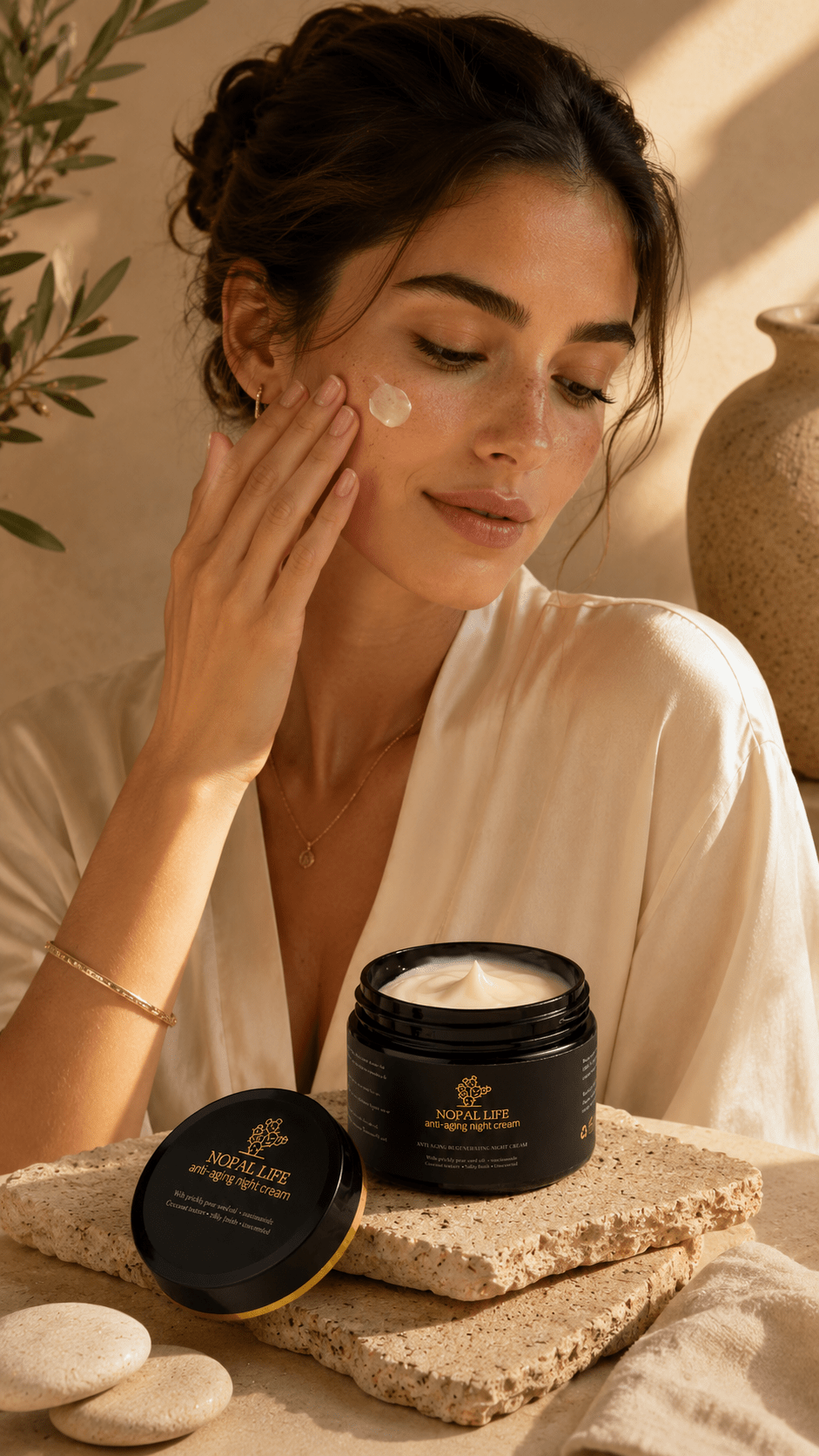
We need to be precise. The anti-aging action of the oil is based on its tocopherols, which limit oxidative damage, and on its supply of fatty acids, which maintains the barrier.
The word "regenerating," often used, actually refers to better renewal conditions, not an acceleration of the cycle. This takes about twenty-eight days, and no cosmetic truly shortens it.
As for rose water, it soothes and refreshes; it is not credited with an action on aging.
The eye contour and other areas
A drop of prickly pear seed oil dabbed with the tip of the ring finger is sufficient for the eye contour. Rose water, on the other hand, can be sprayed all over the face without any particular precautions.
On the neck, décolleté, and hands, the same logic applies: floral water first, then oil, in small quantities.
Quality and preservation
For the oil: first cold press, tinted glass, clear vegetable scent. For rose water: a composition that only mentions distilled petal water, without alcohol or added fragrance.
Both should be stored away from light. Floral water, with very few ingredients, is preferably kept cool once opened.
Limitations
These products are cosmetics and act on skin comfort and appearance, with no curative aim. Persistently irritated or reactive skin warrants a dermatologist's opinion.
Our anti-aging treatments