Prickly pear oil or centella asiatica: which to choose?
One provides substance, the other soothes the skin. Prickly pear seed oil provides essential fatty acids that the skin uses to maintain its barrier. Centella asiatica is a plant extract used for its soothing properties on reactive skin.
Two distinct approaches
For uncomfortable skin, two strategies exist. The first consists of providing what is missing: this is the role of a vegetable oil rich in essential fatty acids. The second consists of calming the reaction: this is the domain of centella asiatica.
Both are legitimate and not mutually exclusive. They simply don't work on the same cause or on the same time scale.
What centella asiatica is
It is a plant long used in traditional Asian medicine, whose extract is widely used in Korean and then European cosmetics. It is often found under the name cica in ranges for reactive skin.
Its compounds—asiaticoside, madecassoside, and asiatic acid—are studied for their soothing action. In practice, centella asiatica is used on skin that reddens easily and on damaged areas.
It is water-soluble and is placed early in a routine, in a serum or a light cream. It provides no lipids.
What prickly pear seed oil provides
Prickly pear seed oil is extracted from the seeds of the Opuntia ficus indica fruit. Its linoleic acid content often exceeds 60%, placing it among the vegetable oils best endowed with this essential fatty acid.
Prickly pear seed oil also contains significant amounts of tocopherols, whose antioxidant action works in the fatty phase of the skin. This combination explains its use on mature skin.
The rarity of prickly pear seed oil is due to its yield: nearly one ton of prickly pears for one liter of oil. The first cold pressing preserves the fragile compounds.
Prickly pear seeds yield an oil rich in omega-6 and vitamin E, two compounds that participate in the defense against free radicals. This is where the often-cited anti-aging benefits of prickly pear seed oil come from.
It nourishes without occluding, making it usable on most skin types. The yield explains its price: nearly a ton of fruit is needed for a liter, and the sorting of the seeds remains largely manual.
Which to choose
Skin that reddens easily, reactive: centella asiatica, for which this is a recognized domain.
Dry, rough, skin lacking suppleness: prickly pear seed oil.
Mature skin: the oil, whose contribution compensates for a deficit that develops with age.
Both at the same time: this is frequent, and the combination works well.
Using them together
Centella asiatica is water-soluble and goes first; prickly pear seed oil finishes the routine.
After cleansing, apply the centella serum or cream to still damp skin. Wait one minute, then two to three drops of oil warmed between the palms.
For skin that is both reactive and dry—a very common case—this combination addresses both dimensions without either hindering the other.
How to apply the oil
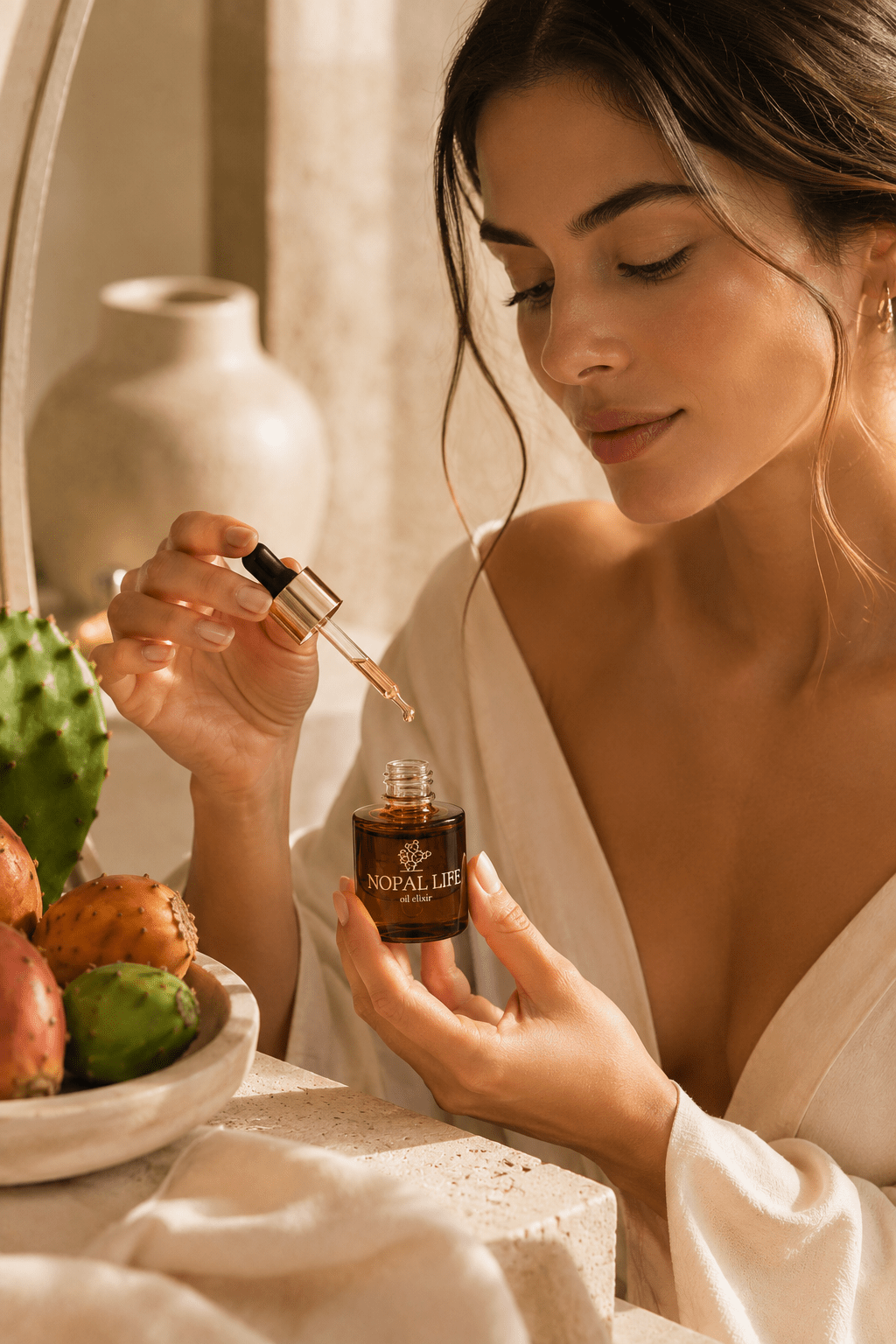
Two to three drops are enough for the entire face, as a last step, on skin that is still slightly damp. Warm them between your palms, then apply with gentle presses rather than firm massage.
For the eye contour, one drop dabbed with the tip of the ring finger. Centella asiatica is also suitable, in a light formula.
How long to judge results
Centella asiatica acts on comfort in one to two weeks. Prickly pear seed oil takes three to four weeks to improve suppleness and skin texture.
Change only one parameter at a time during this period. Introducing both in the same week would make any results unassignable.
What not to expect
Neither one nor the other erases an established wrinkle, acts on spots, or tightens pores. Their common ground is comfort and surface quality.
For skin aging, the most established action remains daily sun protection. Both complement, never replace.
Choosing your products
For centella asiatica: look for the extract at the beginning of the ingredient list, in a short, fragrance-free formula if your skin reacts.
For prickly pear seed oil: first cold pressed, tinted glass, 100% oil composition. A strong plant smell is a good sign; an odorless oil has likely been refined.
A plant from Asia and a cactus from North Africa
Centella asiatica grows in humid areas of Asia; the prickly pear on arid lands. Two opposite environments, two unrelated compositions.
At NOPAL LIFE, prickly pears come from family farms in the arid highlands of eastern Algeria and Kabylie, where the cactus thrives without irrigation. The oil is extracted from the seeds by first cold pressing.
Two ways to approach fragile skin
Centella asiatica acts on the reaction: it calms what is expressed. Prickly pear seed oil acts on the underlying condition: it provides what is missing.
For reactive skin because it is depleted, the second treats the cause and the first makes the wait bearable. That's why opposing them is of little interest.
The price, and what it covers
A centella asiatica extract costs little to formulate; prickly pear seed oil requires nearly a ton of fruit per liter. The price difference reflects this agricultural reality, not a positioning.
The practical consequence: two to three drops of oil as a final layer, where its contribution matters, rather than generous use all over the body.
What you need to know
These products are cosmetics: they act on skin comfort and appearance, without treating skin conditions. Persistent redness requires dermatological advice.
Our anti-aging treatments