Prickly pear and green dam: the oil that holds the earth
Behind every bottle of prickly pear seed oil, there is a plant that is first cultivated to retain soil. In the Algerian highlands, the prickly pear is a tool in the fight against desertification before it becomes a cosmetic active — and it is from these plantations that our oil comes.
The Green Dam: a plant belt against the advance of the desert
Launched in the 1970s, the Green Dam is an Algerian national program designed to slow the progression of the Sahara northward. The idea is simple to state and difficult to achieve: plant a continuous strip of vegetation across the steppe, from west to east, to stabilize the soil and cut the wind that carries away topsoil.
The project experienced mixed decades. The first plantations, largely composed of Aleppo pine, suffered from drought, overgrazing, and difficult maintenance over immense areas. Part of it disappeared.
The program was relaunched in 2020, with a different approach: less forest monoculture, more species adapted to aridity, and the involvement of local populations in the maintenance of the plots. It now covers all the wilayas of the high plateaus, areas where annual rainfall is low and irregular.
Why the prickly pear holds a special place here
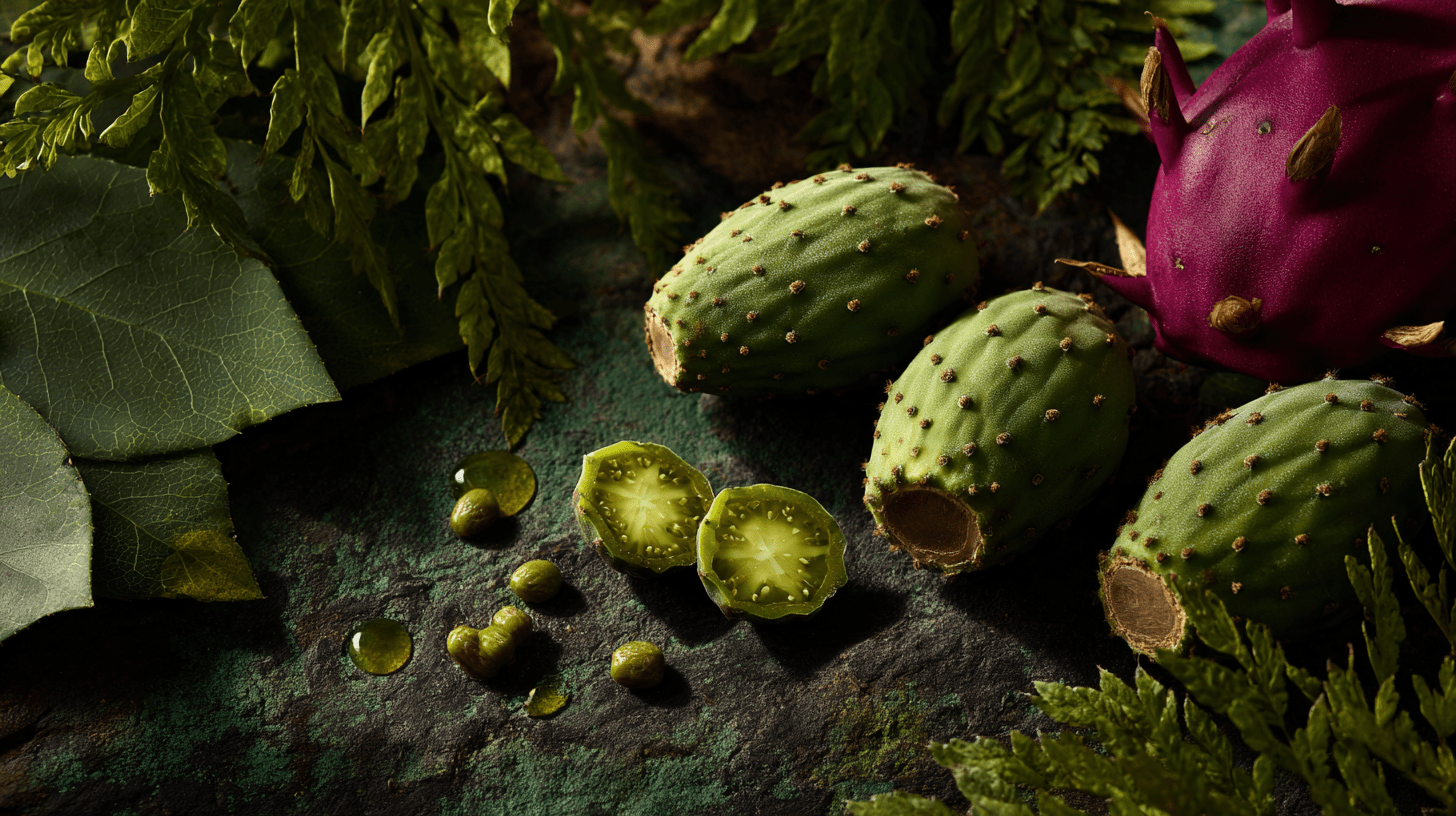
Opuntia ficus-indica presents a rare combination for these terrains. It grows without irrigation, on poor, stony, sloping soils. Its superficial but extensive root system retains soil where it would be carried away by runoff and wind.
Its physiology explains this hardiness. Like other arid plants, it opens its stomata at night rather than during the day, which significantly limits water loss. Its pads store moisture during dry months.
In addition, there are concrete uses for the populations: the pads serve as supplementary fodder when pastures are exhausted, the fruits are consumed or sold, and hedges delineate plots. A plantation that feeds livestock and generates income is much more likely to be maintained than a purely forestry plantation.
Family plantations, not an industry
Our oil comes from artisanal family plantations located in these areas. These are not vast mechanized farms: they are plots held by families, often inherited, maintained by hand.
The harvest is done fruit by fruit, by hand, with mandatory protection: glochids—those tiny, almost invisible spines that cover the skin of the fruit—make any mechanization difficult. The seeds are then separated from the pulp, washed, dried, and then cold-pressed.
This operation explains part of the price. It also explains why the sector remains modest in volume: this type of production cannot be multiplied tenfold in one season.
One ton of fruit for one liter of oil
This is the order of magnitude generally accepted for this oil, and it alone justifies its positioning. The seeds are tiny, and their oil content is low compared to an olive or an argan kernel.
Therefore, a considerable quantity of fruit must be harvested, pulped, washed, dried, and pressed to fill a thirty-milliliter bottle. An oil sold at a very low price on this basis deserves a question about what it actually contains.
The counterpart of this rarity is that it is used in small quantities: two to three drops are sufficient for the face, as the last step in the routine.
What the Algerian framework concretely changes
Two elements are worth knowing. First, genetically modified organisms are prohibited in Algeria, which applies to all crops. Second, a plant that grows without irrigation and without synthetic fertilizers, on land where the challenge is precisely to allow the soil to reconstitute itself, naturally receives very few inputs.
It is important to be precise on this point: the absence of irrigation alone does not guarantee the absence of treatment, and we do not claim otherwise. What can be honestly said is that the agronomic logic of these plots—poor soil, no diverted water, manual maintenance—is consistent with sustainable cultivation.
What this origin does not guarantee
An origin, even a precise and documented one, says nothing about the quality of an oil once pressed. The extraction method, the freshness of the seeds, the temperature, the filtration, and especially the storage conditions count as much as the harvest location.
An oil from an excellent plot but heated during extraction, or stored for a year in a transparent bottle in bright light, will lose what made it valuable. The useful benchmarks remain the same regardless of the country: cold-pressed, opaque or amber bottle, legible expiry date, discreet and non-rancid odor.
An origin also does not replace a consistent routine. Prickly pear seed oil provides lipids and comfort; it replaces neither a moisturizer nor daily sun protection.
Why we tell this story
Because the story of this oil is inseparable from the land where it grows. The prickly pear was not planted in the high plateaus to supply cosmetics: it was planted to keep the soil in place.
That a skin care oil can be derived from it is a consequence, not a starting point. This is what we find interesting to say — more than any adjective about rarity or preciousness.
Frequently Asked Questions
Does the Green Dam really exist today?
Yes. Launched in the 1970s, it went through phases of partial abandonment before being relaunched in 2020 with a revised approach and an extension to all wilayas of the high plateaus.
Does the prickly pear need water?
Very little. It grows without irrigation on arid soils, thanks to a metabolism that limits water loss and pads that store moisture.
Why is this oil expensive?
It takes about one ton of fruit to obtain one liter of oil, with manual harvesting and pulping. The price reflects this rarity and labor.
Does an Algerian origin change the quality of the oil?
Not in itself. The extraction method and storage conditions weigh as much as the harvest location. Documented origin serves traceability, not performance.
Information provided for cosmetic and educational purposes; it does not constitute medical advice.
From this orchard to this bottle
The yield described above — one ton of fruit for one liter — is the reason for the price, and there is no way around it. This is the chain followed by our organic prickly pear seed oil, cold-pressed and unrefined: the origin alone does not guarantee quality, but it explains the cost per liter.
The products mentioned in this article


Mature skin · Dry skin

Go further than this article
Get our skincare guides by email — and start with your free skin diagnostic: 2 minutes, advice tailored to your skin. We ship to the US, UK, Canada, Australia and 27 European countries; somewhere else? Sign up and you will be the first to know when we deliver to your country.
By signing up, you agree to our privacy policy. Unsubscribe in one click.