eye make-up remover: remove without repeated rubbing
The best eye makeup remover dissolves the film without requiring rubbing. The eyelid area is thin, mobile, and close to the mucous membrane; therefore, technique is as important as the formula. The main criterion is the absence of repeated tugging.
The choice of an eye makeup remover is based on observable criteria, reproducible doses, and monitored tolerance over time.
Long-wearing mascaras, pencils, and pigments combine waxes, oils, polymers, and colorants. Water alone does not disperse them well. A bi-phase or oil-based system reduces mechanical effort by solubilizing the oily phase.
Why the eye contour reacts faster
The skin on the eyelids is thinner than on the cheeks and has fewer protective lipid structures. It creases with every blink, which amounts to several thousand movements per day. Sustained daily friction can therefore cause redness and discomfort.
Tears have their own balance. A formula that migrates into the eye can briefly blur vision or sting, even if it is well tolerated on the skin. The quantity and saturation of the cotton pad influence this migration.
The article on the eye contour describes these anatomical peculiarities.
Micellar water, milk, or bi-phase: read the makeup's hold
Micellar water is suitable for light pigments and non-resistant makeup. A milk combines water and lipids in a gentle emulsion. A bi-phase contains an aqueous and an oily phase that needs to be shaken; it is often more effective on waterproof products.
The choice is not based solely on the skin type of the face. Someone with oily skin may need a bi-phase remover for stubborn mascara, followed by a quick rinse to remove the film.
The gentlest formula is one that removes makeup in a few passes.
Surfactants must remain low-interaction
Surfactants have a part attracted to water and another to fats. They form structures capable of carrying away pigments and oils. If they are too concentrated or left on for too long, they can also extract some of the surface lipids.
Non-ionic and amphoteric systems are often chosen for their milder profile. Fragrance does not improve removal and can be avoided in a reactive area.
The chapter on cleansing helps understand this interaction between formula, rinsing, and barrier.
The ten-second application technique
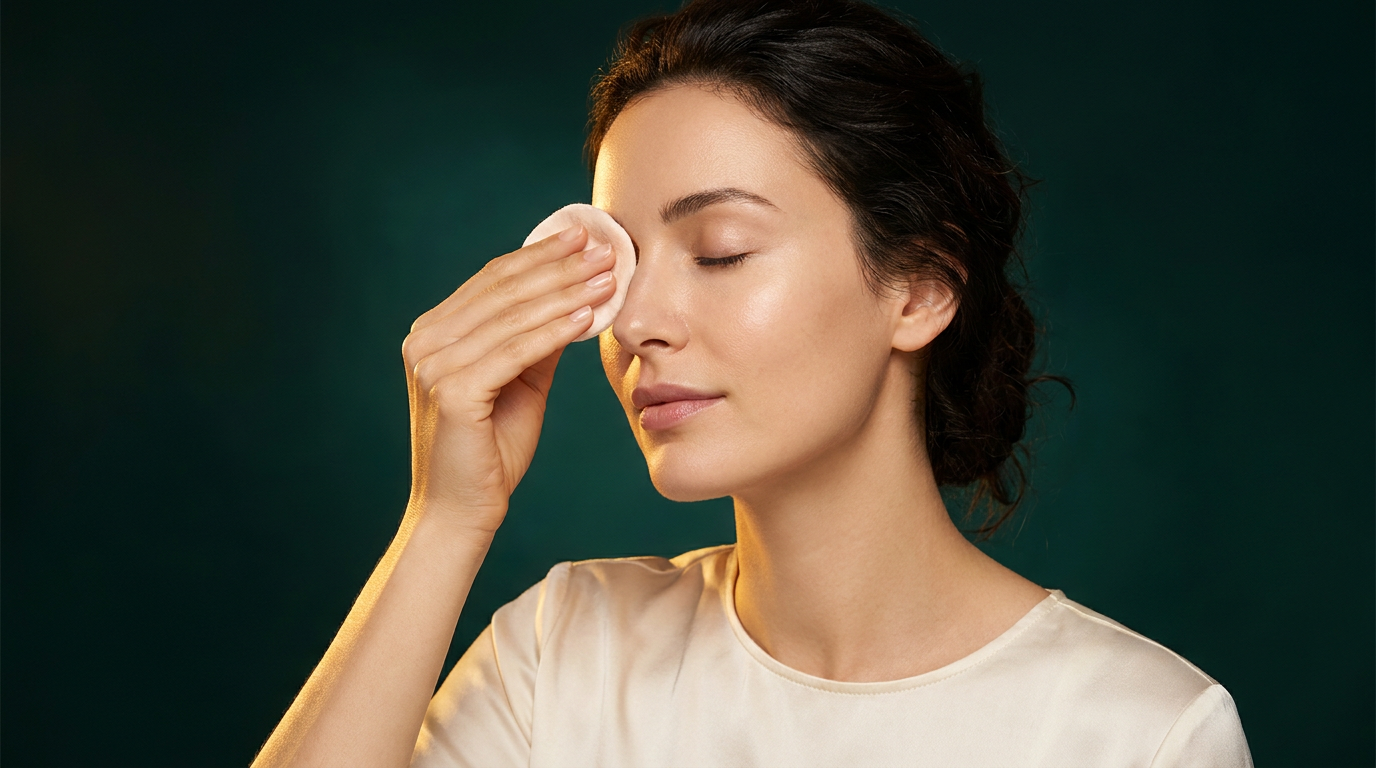
Soak a sufficiently large pad, close your eye, and place it on your lashes for ten to fifteen seconds. This pause allows the solvent to soften the waxes. Then, glide downwards, without back-and-forth movements.
For eyeliner along the lash line, fold a clean cotton pad or use a soft-tipped swab lightly soaked. Work from the outside inwards, keeping your eye closed. A dirty pad redeposits pigments.
- Shake a bi-phase remover until uniformly mixed.
- Hold without pressing the eyeball.
- Glide in the direction of the lashes.
- Change sides as soon as the cotton pad is saturated.
- Rinse if the formula leaves an uncomfortable film.
Lenses, extensions, and waterproof makeup
Lenses should ideally be removed before makeup removal to limit contact with oils and particles. Eyelash extension wearers should follow their professional's recommendations, as some adhesives do not tolerate oils well.
Waterproof mascara requires more oil-based product. Trying to remove it with an overly aqueous product often leads to more passes and thus more friction. The right product reduces the number of gestures.
The guide on double cleansing explains how to combine makeup removal and face washing without unnecessarily repeating steps around the eyes.
| Makeup Type | Suitable Option | Key Action |
| Classic Mascara | Micellar water or milk | Short pause before gliding |
| Waterproof | Bi-phase | Shake then hold for 15 seconds |
| Waxy Pencil | Milk or oil | Local removal with folded cotton pad |
| Glitter | Gentle adhesive support then cleansing | Do not disperse towards the eye |
What "ophthalmologist-tested" really means
This claim indicates that a protocol included specialized supervision, but it does not guarantee perfect tolerance for every user. The nature of the test, the number of volunteers, and the conditions are not always specified on the packaging.
A fragrance-free formula with few ingredients can be simpler to evaluate. A test on a small outer area for several days is still useful, without applying the product directly into the eye.
In case of significant swelling, pain, discharge, or persistent visual discomfort, discontinue use and consult a doctor.
Bottle and accessory hygiene
A contaminated product near the eyes represents an avoidable risk. Close the cap, do not share the bottle, and do not introduce a used cotton pad into the opening. Reusable pads must be rinsed and then washed at the appropriate temperature.
The "period after opening" date, often indicated by a jar symbol, specifies a duration in months. A modified odor, abnormal separation, or unusual color justifies replacement before this date.
The eyes are not an area where you should finish an old, questionable product.
Choosing the right makeup remover based on pigments, waxes, and lenses
An eye makeup remover should dissolve makeup before moving the cotton pad. For classic mascara, micellar water with gentle surfactants may suffice. For waterproof mascara rich in waxes and polymers, a bi-phase containing an oily phase or esters requires fewer passes. For dry or mature skin, a fragrance-free milk limits friction. The useful criterion is not the fresh sensation, but the number of gestures needed to obtain a clean cotton pad.
The eye makeup remover technique proceeds in four steps. Fully soak a soft pad, close your eye, place it for ten to fifteen seconds, then glide from the inner corner outwards without rubbing back and forth. Fold the pad and gently wipe under the lashes. Use a second pad if pigments are still visible. Two slow presses are better than ten quick rubs, as eyelid skin is thinner and easily marked by repeated tugging.
With a bi-phase eye makeup remover, shake the bottle for five seconds to homogenize the two phases. Remove lenses before use if recommended by the instructions. For eyelash extensions, avoid oily substances if the adhesive is incompatible and follow the technician's instructions. An ophthalmologist-tested product indicates an evaluation protocol but does not guarantee the absence of individual reaction. A persistent burning sensation requires abundant rinsing with lukewarm water.
The formula of an eye makeup remover may contain poloxamers, caprylic/capric triglyceride, isohexadecane, glycerin, or panthenol. Essential oils, fragrance, and a high alcohol content are not very useful in this area. For highly pigmented makeup, prefer an oil or bi-phase remover, then rinse with a gentle product if a film remains. Do not rub with a towel: pat for twenty seconds with a clean cloth.
Test the eye makeup remover for seven days, counting the passes per eye. Also note stinging on a scale of 0 to 5, residues upon waking, and lash fallout observed on the cotton pad. A reduction from six passes to two indicates better dissolution. Store pads away from dust, do not share the bottle, and discard any product whose smell or texture has changed.
Quantifying friction instead of just judging texture
Count the number of glides needed to remove eyeliner, powder shadow, and waterproof mascara. Perform the test on each eye with the same amount of product. A well-suited bi-phase can remove mascara in two passes after fifteen seconds of application; insufficient micellar water may require six to eight passes. This difference is important because repeated tugging mobilizes the eyelid and can leave a sensation of warmth. The best choice is often the one that dissolves pigment fastest with the least movement.
The cotton pad also matters. A smooth-surfaced disc retains liquid better than a rough fabric. Soak it to the edges, without it dripping. For the lash line, use a moistened cotton swab and roll the swab instead of rubbing. Do not share accessories. Wash hands before touching the eyelid and close the bottle after each use. If the product enters the eye, rinse for several minutes with clean water and remove contact lenses.
After removal, examine the cotton pad under white light. Black traces indicate that mascara is not fully dissolved; a beige halo may come from concealer. Rinse if the instructions recommend it, then apply a rice grain-sized amount of eye contour cream on the orbital bone, without approaching the lash line. This dose is sufficient for both eyes and limits nocturnal migration.
Frictionless protocol for waterproof makeup. Shake the bi-phase bottle for five seconds. Soak a pad with approximately 1.5 ml of product. Place it on the closed eyelid for ten to fifteen seconds, glide downwards, then fold the pad to remove residues along the lash line.
For classic mascara, micellar water with gentle surfactants may suffice. For waterproof pigments rich in waxes, an oily phase containing esters or triglycerides dissolves the film better. For eyelash extensions, avoid oily substances if the adhesive manufacturer advises against them.
The periorbital skin is thinner than that of the cheeks and has fewer sebaceous glands. Repeated friction of twenty passes can cause more discomfort than a well-dosed bi-phase product. Count the passes: two to four gentle movements should be enough for one eye.
| Makeup | Format | Application Time | Action |
| Classic Mascara | Micellar water | 5 to 10 s | Glide downwards |
| Waterproof | Bi-phase | 10 to 15 s | Press then remove |
| Long-wear pencil | Light oil | 10 s | Cotton swab along lash line |
Remove contact lenses before cleansing. Use a separate pad for each eye. If the product enters the eye, rinse thoroughly with clean water. Persistent discomfort, swelling, or lasting redness warrants professional medical advice.
To check compatibility, test the product for three consecutive evenings without changing mascara or eye cream. Note the number of passes, the presence of a blurry film, and the sensation after fifteen minutes. An effective product should remove pigments with little friction.
After removal, wipe with a damp, product-free cotton pad to remove surfactant residues, then pat dry. Then apply a rice-grain-sized amount of eye contour gel-cream, dabbing on the orbital bone rather than along the lash line.
Cleansing the lash line. Soak a cotton swab with the bi-phase remover, close your eye, and sweep it horizontally along the base of the lashes. Use a clean end for each pass. Then rinse with a water-moistened cotton pad.
A pump bottle limits contact with air and fingers. Do not share the product and never dip a used cotton pad into the bottle. Replace it if the formula changes smell or if an unusual separation persists after shaking.
What a removal product should not claim
It does not lengthen lashes and does not permanently alter under-eye bags or wrinkles. Its mission is brief: dissolve, remove, and leave the area comfortable. Added active ingredients have little contact time before rinsing.
Nor does it justify prolonged massage. More rubbing does not mean more cleanliness; it often indicates a mismatch between makeup hold and the solvent system.
The expected result is simple: no visible pigment, few passes, and no persistent discomfort.
Dissolve rather than rub
Stubborn makeup does not yield to persistence but to the appropriate solvent: waxes and waterproof pigments are lipophilic, so a fatty phase removes them in a few seconds. A gentle cleansing oil applied for ten seconds before emulsifying reduces the number of passes, which is the sole objective in this area.
Our anti-aging treatments