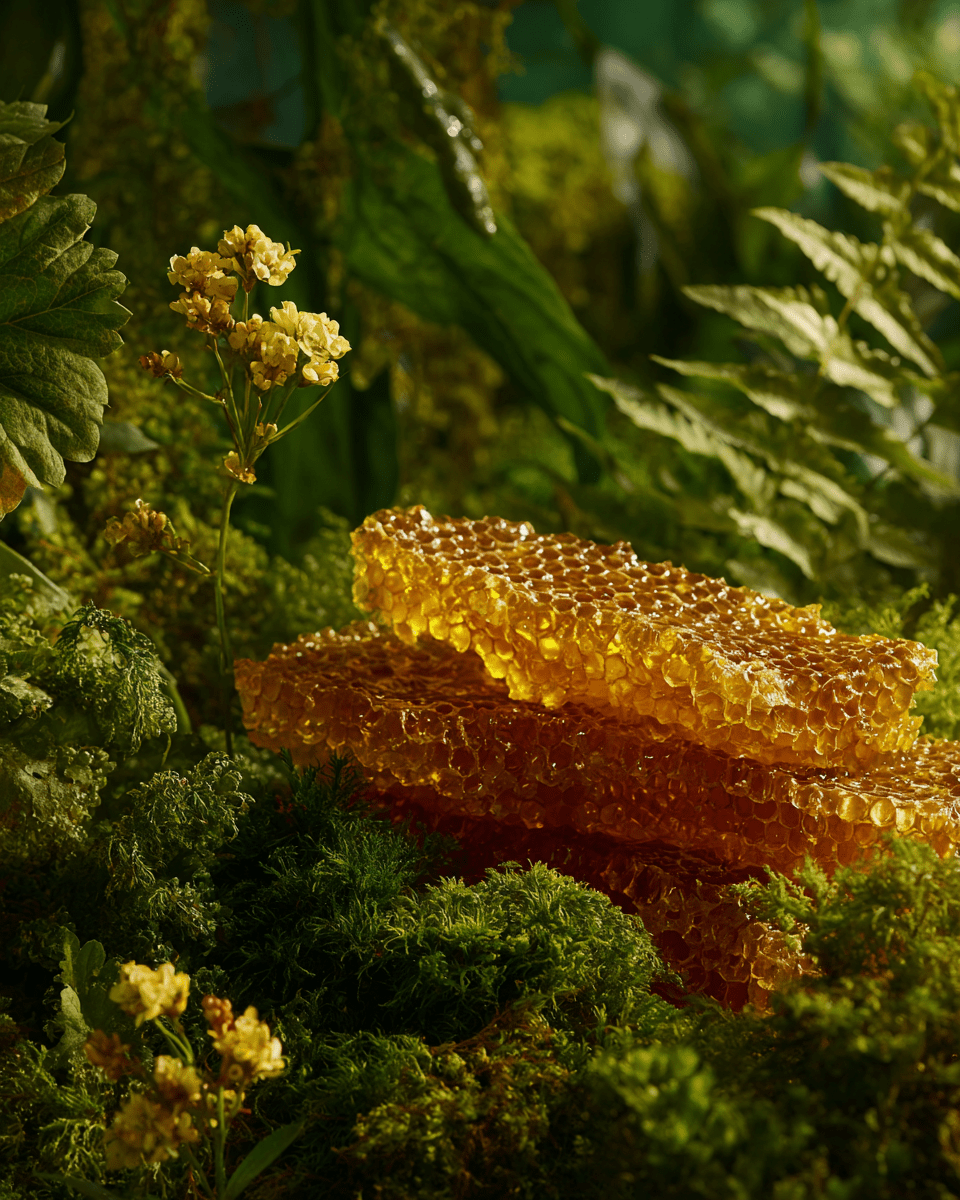
Cosmetic honey: natural humectant and soothing properties
Choosing the right active ingredients is already taking care of your skin. Cosmetic Honey: here is the complete guide to this ingredient — cosmetic properties, application techniques, synergies — to integrate it accurately into your ritual.
Cosmetic honey: composition and benefits for the skin
Honey is one of the oldest cosmetic active ingredients in the world — Egyptian papyri already mention it as a skincare ingredient 4,000 years ago. But its value far exceeds ancestral empiricism: its composition reveals remarkable richness. Composed of 80% carbohydrates (fructose, glucose, maltose, sucrose), 17-20% water, and less than 1% other components, it is in this minor fraction that the essence of its cosmetic interest lies: enzymes (glucose oxidase, catalase, diastase), organic acids (gluconic, citric, acetic), vitamins (B1, B2, B3, B5, B6, C), minerals (calcium, potassium, magnesium, zinc), phenols and flavonoids with antioxidant properties, and peptides. Its naturally acidic pH (3.2-4.5) is close to the skin's pH, making it an active ingredient that respects the skin's balance. Honey's flavonoids and polyphenols are renowned for their antioxidant properties, valued in cosmetics to help preserve skin radiance over time.
Honey as a natural humectant: honey hydration
Honey's humectant property is one of its best-known. It relies on its natural hygroscopicity: honey attracts and retains water molecules from the atmosphere thanks to its hygroscopic sugars (especially fructose) and organic acids. When applied topically, it forms a thin film on the skin's surface that helps limit water evaporation and capture ambient moisture to help maintain comfort in the superficial layers. This dual mechanism — retention and capture — makes it a particularly valued humectant in environments with variable humidity. Glycerol naturally present in some honeys amplifies this hygroscopic effect. Compared to pure hyaluronic acid, honey offers a more lasting but less immediate hydrating sensation, and its humectant effect is enhanced in slightly humid environments (application on freshly washed, undried skin). Modern cosmetic formulations incorporate honey as a natural humectant in serums, masks, and balms at 5% to 30%, taking advantage of its exceptional biocompatibility and multidimensional range of uses.
Purifying and soothing properties: honey for skin comfort
Honey's purifying properties are among its most appreciated cosmetic uses. Several characteristics converge to make it a choice ingredient in purifying care. Firstly, its high sugar concentration gives it an osmotic effect. Secondly, the glucose oxidase it contains is associated with its traditional use in purifying care. Thirdly, its acidic pH (3.2-4.5) contributes to respecting the skin's balance. Fourthly, flavonoids and phenols contribute to its overall purifying action. Manuka honey (NPA 10+), rich in methylglyoxal (MGO), is particularly renowned for its benefits in purifying care. These properties make it a valuable active ingredient for blemish-prone skin, sensitive areas, and daily comfort care. Its complementary soothing qualities, appreciated by reactive skin, reinforce its cosmetic value.
Mistakes to avoid with honey in cosmetics
The first mistake is confusing quality and origin: not all honeys are equal in cosmetics. Industrial honey heated above 40°C loses a large part of its enzymes and phenols. Prioritize raw organic cold-extracted honey, or UMF/MGO certified Manuka honey for purifying uses. The second mistake is letting a pure honey mask dry completely: honey becomes sticky and difficult to rinse when it loses its moisture, creating an unpleasant sensation and aggressive rinsing. A honey mask should be kept on damp skin for 15-20 minutes and rinsed with lukewarm water in gentle movements. The third mistake is applying it to very dehydrated skin in a dry environment: in the absence of atmospheric humidity, the humectant can create a tight sensation. The fourth mistake is ignoring the risk of sensitivity (pollen allergy): people sensitive to pollen or bee stings should perform a tolerance test before any facial application.
Integrating honey into an effective natural skincare routine
Honey can be integrated into a skincare routine in many ways. As a weekly pure mask (or mixed with yogurt, clay, or royal jelly), it provides an intense hydrating sensation, immediate radiance, and a gentle purifying action — ideal for dull, combination, or blemish-prone skin. As a cleanser, a small amount of raw honey on wet skin, gently massaged then rinsed, is one of the gentlest and most skin-balance-respecting cleansers. In a lip balm, honey is the ideal base active ingredient for chapped and dehydrated lips. In a homemade serum, it can be incorporated at 5-10% into a floral water and hyaluronic acid base. Combining a honey mask (humectant hydration) with a ceramide cream (lipid sealing effect) creates a complete hydration synergy that addresses both skin comfort needs.
Honey and the Nopal Life universe: humectation and naturalness
In the Nopal Life philosophy, honey embodies the same vision as prickly pear: natural active ingredients of a richness that synthesis cannot replicate identically. Prickly pear oil and honey form a perfect cosmetic association: honey provides aqueous moisture and purifying action, while prickly pear oil helps seal this hydration and nourishes the lipid barrier. This duo can be used as an express mask (1 teaspoon of honey + 3 drops of prickly pear oil, 15 minutes, gentle rinsing), offering in a single application the benefits of humectant hydration and lipid nutrition. Nopal Life recommends raw thyme or rosemary honey from the Maghreb, rich in polyphenols, as a complementary cosmetic partner to its range. This binary approach — water and lipids, humectation and nutrition — is at the heart of the Nopal Life philosophy: a beauty that understands the skin in all its richness and provides it with exactly what it needs.
Frequently Asked Questions
Q: Is honey suitable for oily and blemish-prone skin?
A: Yes, this is one of its most popular applications. Its purifying action helps care for blemish-prone skin, its acidic pH supports skin balance, and its texture does not clog pores. Prefer Manuka honey (MGO 250+) for maximum purifying effect.
Q: Can supermarket honey be used for facial care?
A: Regular liquid honey can be used, but raw organic first-extraction honey is significantly richer in enzymes and phenols. Industrially heated honey loses a large part of its enzymes — so the cosmetic benefit is reduced. Investing in quality raw honey makes a real difference.
Q: Can honey cause breakouts or blackheads?
A: No for blackheads — its comedogenic index is zero. However, people sensitive to bee products or pollen may develop a skin reaction. Test on the inside of the elbow before facial use and wait 24 hours.
Q: What is the difference between ordinary honey and Manuka honey?
A: Manuka honey (Leptospermum scoparium, New Zealand/Australia) contains methylglyoxal (MGO), a compound renowned for its unique purifying benefits. Its purifying benefits are stable and particularly appreciated. For comfort uses or blemish-prone skin, Manuka MGO 250+ is highly valued.
Q: How long can cosmetic honey be stored?
A: Pure honey, properly stored away from humidity and light, can be kept for years or even decades without degrading (honey crystallizes but remains usable). Gentle heating in a bain-marie at maximum 40°C softens it without altering its qualities. Never store in a damp container.
Q: Can honey replace an exfoliant on dull skin?
A: Partially. Honey enzymes have a mild exfoliating action that helps free the skin from superficial cells. Its action is very gentle, ideal for sensitive skin, but insufficient for a thorough exfoliation. Combine with fine rice or almond powder for a more complete action on non-sensitive skin.
Q: Can honey be used on sunburn?
A: Yes, in moderation. In case of significant or persistent skin discomfort, consult a healthcare professional.
RECOMMENDED TREATMENT
Pure Prickly Pear Seed Oil
Natural formula - Origin Algeria
DISCOVER THIS TREATMENTRead more
Information provided for cosmetic and educational purposes; it does not constitute medical advice.


Go further than this article
Get our skincare guides by email — and start with your free skin diagnostic: 2 minutes, advice tailored to your skin. We ship to the US, UK, Canada, Australia and 27 European countries; somewhere else? Sign up and you will be the first to know when we deliver to your country.
By signing up, you agree to our privacy policy. Unsubscribe in one click.