



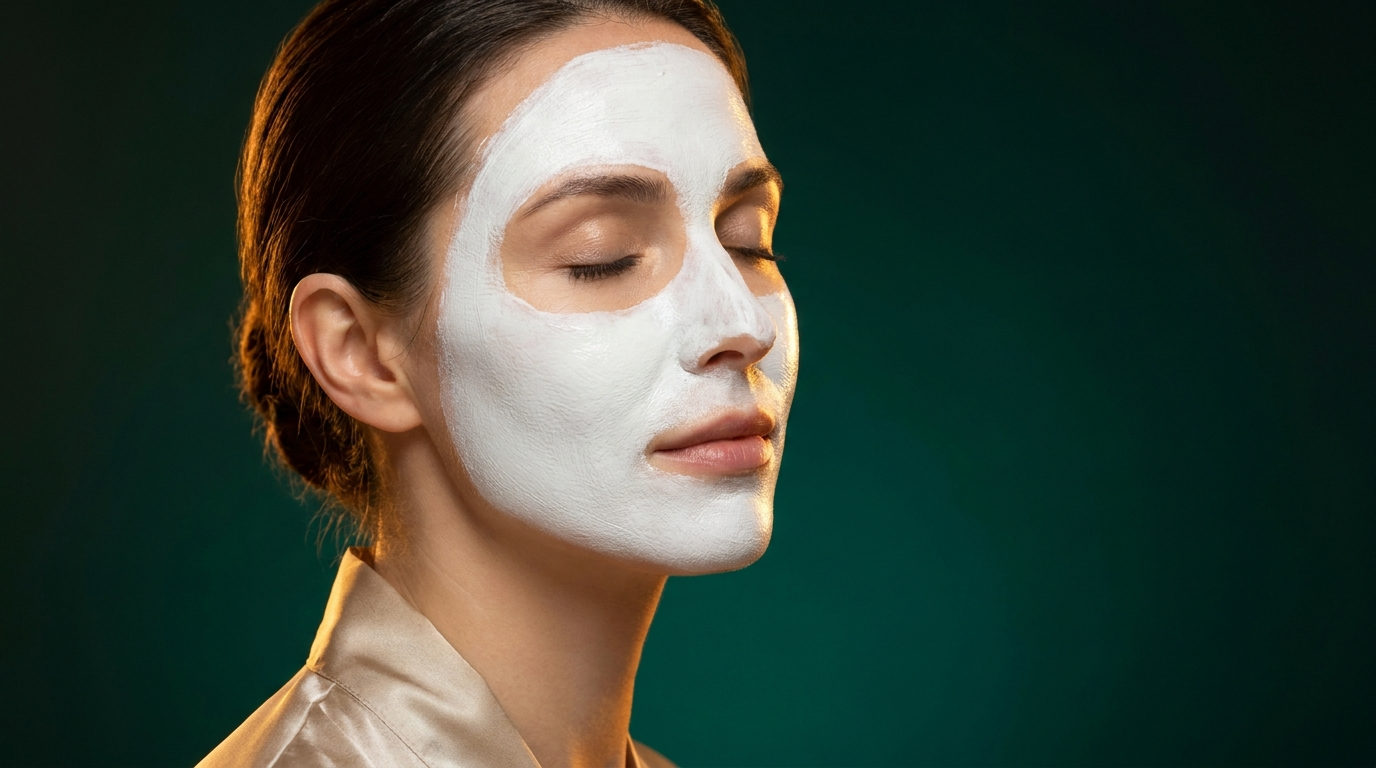
White facial mask: kaolin, film, and instructions for use
"White face mask" refers to two products that have nothing in common: a white clay mask, or a mask that dries into a white film. The first absorbs, the second peels off. Their application times, indications, and risks are opposite, and it's the INCI that decides—not the color of the jar.
Two products behind one name
The distinction can be seen in three seconds on the ingredients list.
Kaolin at the top of the list: this is a white clay mask. It's applied in a thick layer, rinsed off, and its action relies on sebum adsorption.
Polyvinyl Alcohol or PVP: this is a peel-off mask. It dries into an adhesive film and is removed in one piece. Its action is mechanical.
A third case exists: masks with zinc oxide or titanium dioxide, which are white due to their mineral pigments and soothe or mattify without belonging to either of the previous two families.
Confusing the three leads to concrete errors: letting clay dry when it should have been rinsed while damp, or expecting a peel-off mask to absorb when it doesn't.
Kaolin, the gentlest clay
Kaolin is a clay rich in kaolinite, with a very fine particle size and moderate absorption capacity.
It is precisely this moderation that makes it the clay for sensitive, dry, and mature skin. Green clay, which is much more absorbent, dries out where kaolin merely mattifies.
| Clay | Absorption | For whom |
|---|---|---|
| White (kaolin) | moderate | dry, sensitive, mature skin |
| Pink | moderate | combination, reactive skin |
| Green (illite) | strong | oily skin, T-zone |
| Rhassoul | strong, cleansing | oily skin, scalp |
In a powdered product, kaolin appears in the first position. In a ready-to-use cream, it is combined with water, glycerin, and emollients that prevent it from drying out. See the kaolin clay fact sheet.
Kaolin and water recipe, the basic
One level tablespoon of superfine powdered kaolin.
One tablespoon of water or floral water, added gradually.
Mix with a non-metallic spatula—prolonged contact with metal alters the properties of clay—until you get a smooth cream. Add the liquid drop by drop if the paste remains thick: the opposite is impossible to fix.
Spread a thick layer, leave for eight to ten minutes, then rinse with lukewarm water before it completely dries.
Once to twice a week for oily skin, once every ten days for sensitive skin.
Three variations
Dry skin. One tablespoon of kaolin, one teaspoon of honey, half a teaspoon of sweet almond oil, a little water. The honey and oil compensate for the absorbent effect.
Sensitive skin. One tablespoon of kaolin, half a teaspoon of colloidal oatmeal, chamomile floral water. Leave on for only five minutes.
Combination skin. Kaolin on the cheeks, green clay on the T-zone, applied at the same time. This is the zone-specific approach, and it's the main advantage of homemade products.
Two drops of glycerin in any of these formulas prevent the paste from cracking before the end of the application time.
Why you should never let it dry
This is the most common mistake, and it completely reverses the mask's effect.
As long as the clay remains moist, it absorbs surface sebum. As soon as it dries, it has nothing left to absorb and begins to draw water from the skin through capillarity.
The tightness of cracked clay is therefore not a sign that it's working: it's a sign that it's dehydrating. And dehydration triggers an overproduction of sebum in reaction, exactly the opposite of the desired goal.
Mist lightly if the paste starts to mattify, and rinse at the first signs of drying. A supple clay for ten minutes is better than a hardened clay in five.
White peel-off masks
They form the other half of the search, and they deserve a warning.
Their effect does not come from any active ingredient but from polyvinyl alcohol, a glue that dries into a film. This film latches onto anything protruding: dead skin cells, peach fuzz, sebaceous filaments.
What is removed mainly consists of sebaceous filaments—normal structures of each follicle—and not blackheads. They reform in a few days.
The price is real: repeated tearing weakens the pore opening, which then appears larger, and removes part of the stratum corneum. On sensitive skin, reactions are common.
A rinsed mask provides the benefit without the mechanical trauma. This is the only form to retain.
Rinsing, an underestimated step
Rubbing to remove the clay cancels out some of the benefits and irritates delicate areas.
Wet thoroughly with lukewarm water, let the clay rehydrate for thirty seconds, then gently slide it off with your fingertips without pressing. Finish by dabbing with a soft cloth.
Then apply a moisturizing treatment within minutes. This step prevents sebaceous rebound, and it's the one most often skipped, thinking that oily skin doesn't need it.
Precautions
- Glass or ceramic bowl, wooden or silicone spatula. Never metal.
- Test on the crook of your elbow twenty-four hours before trying a new formula.
- Avoid the eye area and lips.
- Do not combine with an exfoliant or an acid on the same evening: space them out by at least three days.
- Prepare a single dose. Without preservatives, an aqueous mixture becomes a culture medium in a few hours.
- Store the powder dry, in its original packaging.
What a white mask does not do
It doesn't lighten the complexion. The color of the product has no relation to its action: kaolin is white because kaolinite is, not because it depigments.
It doesn't tighten pores. Their diameter depends on genetics and sebum production. An unclogged pore appears smaller, but its anatomy doesn't change.
It doesn't act on spots or wrinkles. See our guide to dark spots for what truly works on pigmentation.
And it doesn't replace any routine step. A weekly mask doesn't compensate for insufficient cleansing, lack of hydration, or absence of sun protection. See our homemade face mask guide.
What a clay mask doesn't restore
Kaolin absorbs, and that's it: it removes without replenishing anything, hence the tightness when it's left to dry. Alternating with a prickly pear face mask, which is more nourishing, ensures that the week isn't just about stripping actions.


Go further than this article
Get our skincare guides by email — and start with your free skin diagnostic: 2 minutes, advice tailored to your skin. We ship to the US, UK, Canada, Australia and 27 European countries; somewhere else? Sign up and you will be the first to know when we deliver to your country.
By signing up, you agree to our privacy policy. Unsubscribe in one click.

