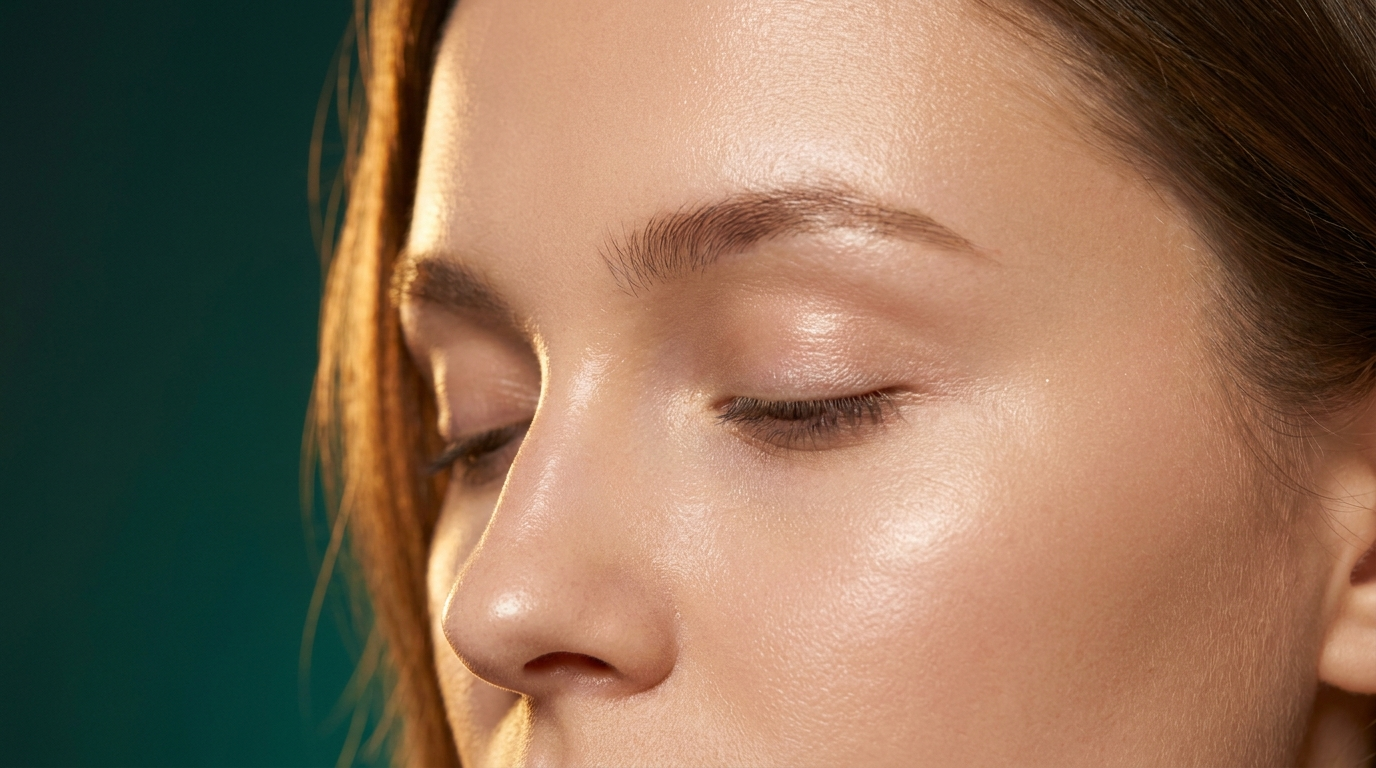
Frown lines: understanding the crease between the eyebrows
A frown line is a vertical expression line located between the eyebrows. It gets its name because it deepens when one frowns—an expression of annoyance, concentration, or glare. Its particularity lies in its origin: it is caused by a muscle, not by a lack of care. This determines what cosmetics can and cannot do.
A mechanical crease before it's a sign of aging
The corrugator muscle, located under the skin at the root of the nose, draws the eyebrows together. With each contraction, the skin creases perpendicularly to the muscle fiber. Repeated thousands of times, this flexion eventually marks the dermis like a crease marks paper folded in the same spot.
Two practical consequences. First, it often appears early—around thirty in very expressive people, sometimes earlier. Second, it doesn't depend on skin type: oily and well-hydrated skin can clearly show it.
It is also called a glabellar line, from the Latin glabella which refers to the space between the eyebrows. It is also referred to as a glabella line. This vertical crease is deepened by the repeated contractions of the muscles located in this area—the corrugator and procerus are the responsible muscles—and not by skin sagging.
Frowning is the cause, and it is almost entirely involuntary: concentration, a poorly adjusted screen, bright light, inadequate optical correction. A person who works eight hours in front of a poorly lit screen accumulates thousands of repeated contractions per day without being aware of it.
A word on the name. It is called a lion's wrinkle by analogy with the crease the animal has between its eyes, and this image clearly conveys what it is: a mark of expression, not a mark of time. The two resemble each other but do not have the same cause.
What deepens it faster
Expressiveness is the main factor, but three circumstances amplify it without us thinking about it.
Glare. Squinting in the sun or at a screen mobilizes exactly this muscle. Poorly adapted corrective lenses or the absence of sunglasses maintain the contraction for several hours a day.
Prolonged concentration. Work-related frowning is involuntary and rarely perceived.
Loss of elasticity. Over time, the dermis recovers less well after each flexion. The crease, once visible only in movement, becomes perceptible at rest. This transition is what causes concern, and it is gradual.
The frown line, also called the glabellar line, appears earlier in very expressive people and in those who squint. It's a matter of mechanics, not character: it's the first years of habit that establish the crease.
Therefore, smoothing the frown line sustainably requires acting on the gesture as much as on the skin. Correcting one's vision, adjusting screen brightness, getting enough sleep: these three measures help reduce the number of daily contractions, and this is the only natural lever that acts upstream.
Dynamic wrinkle or established wrinkle: the test
In front of a mirror, with direct light, look at the area at complete rest, with a relaxed face. If the furrow disappears, the wrinkle is still dynamic—it only exists with contraction. If it remains visible, the dermis is marked.
| Dynamic wrinkle | Established wrinkle | |
|---|---|---|
| At rest | invisible or very faded | persistent furrow |
| What helps | prevention, awareness of the gesture | suppleness and hydration of the dermis |
| What to expect | slow down its establishment | reduce its appearance, not erase the crease |
The test takes ten seconds in front of a mirror. Completely relax your forehead: if the crease disappears, the wrinkle is dynamic and only visible when the muscles contract. If it remains, it is established, and the furrow has deepened into the dermis.
The frown line almost always appears in the first form before transitioning to the second, over years. Repeated muscle contractions first create a reversible crease, then a permanent mark. This is why the first years are the most profitable: one acts on the cause as long as there is no furrow yet.
For a severe, already established form, only aesthetic medicine has direct means—Botox acts on the muscle, fillers on the hollow. These techniques are performed by a doctor; naming them here serves to define what cosmetics can and cannot do.
What skincare actually provides
Supple and well-hydrated skin returns to its shape better after each flexion. This is a modest but real effect, and it mainly acts as a preventative measure.
The relevant active ingredients for this area are those that support density and suppleness: retinol or its plant-based alternative bakuchiol for renewal, hyaluronic acid for water content, vitamin C as a cofactor for collagen synthesis.
What no topical treatment does: relax a muscle. Formulas that suggest an "injection-like" effect describe an action that cosmetics cannot produce. Honesty on this point is better than a promise that will disappoint in six weeks.
Regularly applied skincare can improve the appearance of the area: the skin is more supple, the crease catches less light, and the mark appears less deep. These are real effects, measurable in photos, and limited to the surface.
They do not prevent the frown line from appearing or deepening if the gesture that produces it continues. That's why understanding what mechanics dictate about this wrinkle is better than expecting from a product what it cannot deliver.
The application technique that matters
This area should be worked flat, never by pinching. Place two fingers on either side of the furrow and gently stretch outwards while applying the product, without rubbing. The goal is to deposit the product into the crease rather than leaving it on the surface.
A brief forehead massage, with palms moving up from the eyebrows to the hairline, relaxes the muscle after a day of concentration. This is a gesture of relaxation, not a treatment.
The direction of movement matters more than the product. Apply perpendicular to the crease, meaning horizontally on a vertical wrinkle, gently stretching the skin between two fingers so that the product reaches the bottom of the furrow.
The opposite gesture, vertical, follows the crease and accentuates it. This is the natural reflex and it achieves the exact opposite of what is desired. Thirty seconds morning and evening are sufficient, provided these thirty seconds are done in the right direction.
Photoprotection, an underestimated lever
Ultraviolet radiation degrades collagen and elastin fibers in the dermis—this is the primary avoidable factor in skin aging. In an area already mechanically stressed, this degradation accelerates the transition from dynamic to established wrinkles.
Wearing sunglasses works twice: protecting the dermis and suppressing the squinting reflex.
Protecting your skin from the sun works in two ways here. Radiation degrades the fibers that allow the crease to close, and it darkens the furrow once established, making it more visible at equal depth.
This area is particularly exposed due to its orientation, and it is almost always forgotten: we protect the cheekbones and nose, rarely the space between the eyebrows. A cap does as much here as a product, and often better, because it doesn't wear off in the middle of the day.
It is the only natural lever that acts both on what deepens the wrinkle and on what makes it apparent. It also helps to delay the moment when the question of a medical procedure arises.
What to expect, and in how long
For a still dynamic wrinkle, a regular routine combined with reduced frowning visibly slows down its establishment. For a marked wrinkle, improvement concerns its appearance—a less defined furrow, more supple skin—and is measured in months, not weeks.
Beyond that, techniques that act on the muscle are the domain of a doctor. The face routine for wrinkles and fine lines covers all daily actions.
For more details on this specific point, see our guide Frown Lines in Women.
PERSONALIZED ROUTINE
Nopal Life Skin Intelligence™
Free diagnostic · 2 minutes
DISCOVER MY ROUTINE →Two ambitions must be distinguished. Reducing wrinkles in terms of surface appearance is within the reach of a regular routine: one smoothes the texture, hydrates, protects from the sun, and the crease appears less marked after two to three months.
Treating the frown line in the sense of removing it is another matter. A crease maintained by a muscle that continues to contract does not disappear through cosmetic means. Techniques that act on the muscle itself—botulinum toxin—or that fill the furrow—hyaluronic acid injections—fall under aesthetic medicine and require a consultation. They are mentioned here to delineate the boundary, not to recommend them.
Between the two, a free gesture goes a long way: checking one's eyesight and the lighting of one's workstation. This is the only solution that acts on the cause rather than the result.
What a treatment can do, once the crease is identified
For a still dynamic wrinkle, a renewal active ingredient works on the quality of the surface, not on the contraction that creates it—it's a supplement, not the answer. A bakuchiol serum fulfills this role with better tolerance than retinol, which is important for an area treated for months.


Go further than this article
Get our skincare guides by email — and start with your free skin diagnostic: 2 minutes, advice tailored to your skin. We ship to the US, UK, Canada, Australia and 27 European countries; somewhere else? Sign up and you will be the first to know when we deliver to your country.
By signing up, you agree to our privacy policy. Unsubscribe in one click.