Centella asiatica: titration, timelines, and 12-week protocol
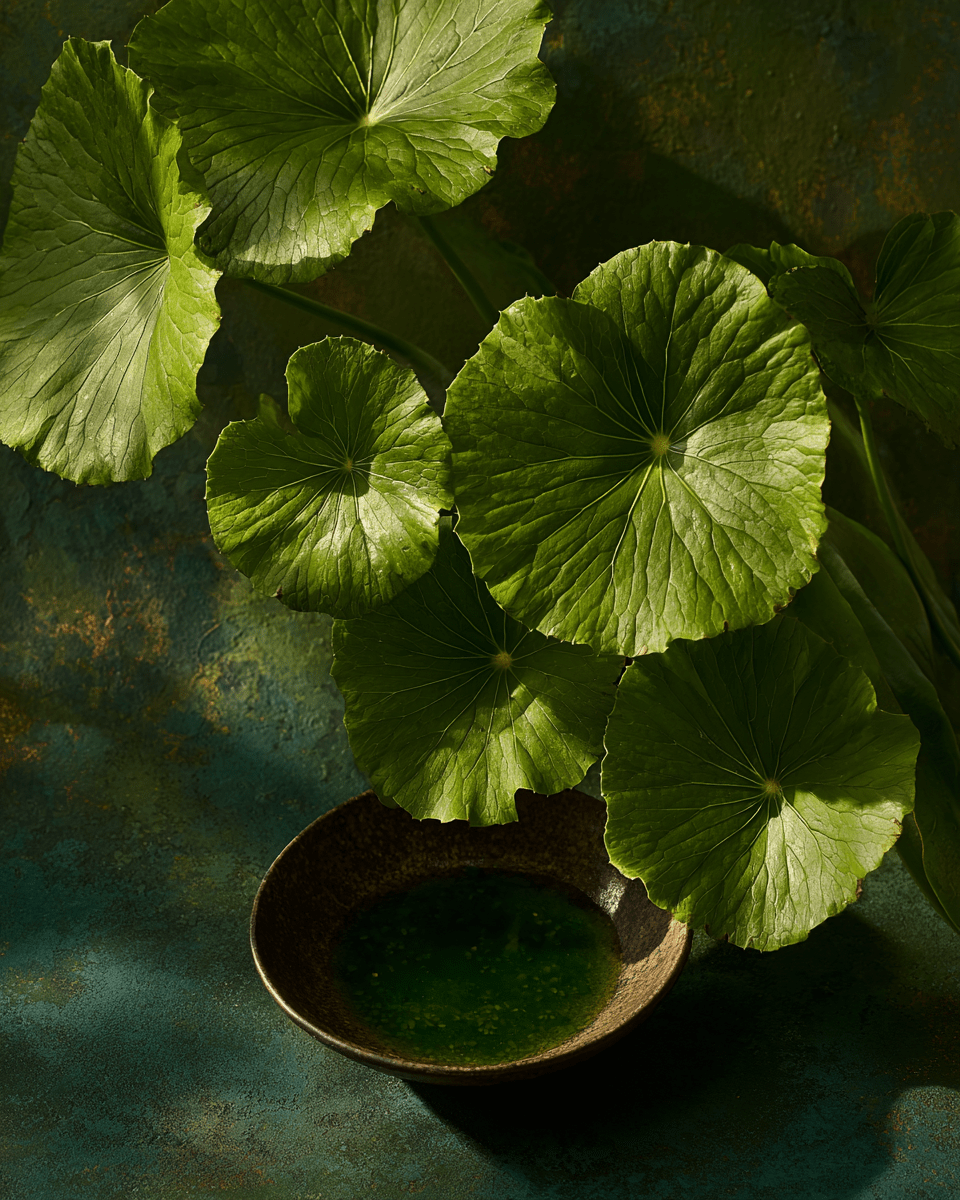
For ten years, the same name has appeared on bottles, in Korean routines, and in the INCI lists of natural cosmetics: centella asiatica. Behind this name lies a creeping herbaceous plant from Southeast Asia, also cultivated in Madagascar and Sri Lanka, of which almost exclusively the leaves are used. This guide does not merely call it "soothing": it provides the titrations, observation times, and label reading method that distinguish a genuinely dosed extract from a mere marketing claim.
If your skin is mature, dull, prone to visible redness, or if you notice a visible loss of firmness on your facial contours, the real question is not whether this active ingredient might interest you, but in what form, at what dose, and for how long.
Key takeaways
- Full botanical name: Centella asiatica (L.) Urb. "Gotu kola", "tiger grass", and "CICA" refer to the same plant.
- What matters is not the mention on the packaging, but the triterpene titration: TTFCA (total triterpenic fraction), TECA or Centellase indicate a standardized fraction.
- Four molecules are of cosmetic interest: asiaticoside, madecassoside, and their two aglycones. Their distribution is standardized (table below).
- Typical titrations in facial care: 0.1% to 1%. Below 0.05%, the observed effect is marginal.
- Comfort is felt within 48 to 72 hours; firm appearance and radiance require 8 to 12 weeks.
- Traditional oral uses — herbal tea, infusion — do not translate into cosmetic claims.
One plant, five different names
The first confusion lies in the vocabulary. A "tiger grass" fluid, a "CICA" cream, and an organic product with a titrated extract contain the same plant material. The names change according to tradition, market, and era.
| Name encountered | Origin of the name | What it truly tells you |
|---|---|---|
| Centella asiatica (L.) Urb. | Official botanical nomenclature; "Urb." refers to botanist Ignatz Urban. | The species name, not the extract name. No dosage information. |
| Gotu kola | Sinhalese name, adopted into Western herbal medicine vocabulary. | Often indicates an herbalism or food supplement positioning. |
| Herbe tigre / tiger grass | Popular name, linked to a field anecdote about tigers. | Purely marketing. Assumes neither quality nor dosage. |
| CICA | Abbreviation popularized by K-beauty from 2016. | A comfort category. Look for "standardized CICA" or a fraction acronym. |
| Brahmi | Ambiguous Sanskrit name: it sometimes refers to Bacopa monnieri, a different species. | Always check. The term alone guarantees nothing. |
Where the leaves used come from
This herbaceous plant thrives in humid, tropical environments. Four supply chains feed the market, each with noticeably different profiles.
| Origin | Supply chain status | What formulators expect from it |
|---|---|---|
| Madagascar | Regulated harvesting and dedicated cultivation; historical source of titrated extraction. | Madagascar centella is the reference for European standardized fractions. Documented traceability. |
| India / Sri Lanka | Traditional cultivation linked to Ayurvedic medicine and food. | Volume oriented towards supplements; cosmetic batches with titration require a certificate of analysis. |
| Southern China / Vietnam | Mass production, often as non-titrated dry extract. | Low cost, high lot-to-lot variability. Common in entry-level products. |
| South Korea | Local crops valued by K-beauty brands. | Proprietary complexes; exact titration is rarely disclosed. |
A useful technical point: it is the leaves that concentrate the triterpenes, more so than the stolons or roots. The mention Centella Asiatica Leaf Extract is therefore more precise than Centella Asiatica Extract, which can refer to the entire aerial part.
From Ayurvedic herbal tea to bottle: what translates and what doesn't
The documented use of this species dates back several centuries in India and China. In Ayurvedic medicine, the leaves were consumed as herbal tea, infusion, or paste. Tradition attributed virtues related to blood circulation to them — a discourse of oral herbal medicine, which was never intended to describe what a cream does. This is the most frequent confusion found online, and it deserves to be clearly addressed.
An herbal tea falls under the oral route and herbal medicine, governed by distinct regulations. A cosmetic applied to the epidermis affects the appearance, comfort, and surface hydration, and nothing more. Three abusive transpositions are circulating, which should be recognized:
- Circulation. When a cream promises to "activate circulation," it transposes an infusion use to a topical one. A sign of mistrust, not an argument for quality.
- Healing. The word constantly comes up in relation to this species. Healing is a physiological process that falls under medical care: no cosmetic can claim it, no matter how rich its extract.
- Uses beyond the face. The same raw material is found in comfort herbal teas, body care, or hair care. These markets follow other rules, and hair products in particular are not judged on the same criteria; this guide only addresses facial care.
What cosmetics retain is more modest, and verifiable through use: a triterpenic fraction valued for its soothing properties — immediate comfort, soothing the appearance of redness — and an excellent tolerance profile on reactive skin.
The four triterpenes, as read by a formulator
All the value lies in four molecules. Two are glycosides (carrying a sugar, therefore water-soluble), two are the corresponding aglycones, with higher relative molecular weight and significantly more lipophilic. This difference explains why some active ingredients end up in an aqueous serum and others in a balm.
| Molecule | Nature | Proportion in the titrated fraction | Solubility | Preferred galenic form |
|---|---|---|---|---|
| Asiaticoside | Triterpenic glycoside | ≈ 40% | Water-soluble | Aqueous serum, essence, lotion, sheet mask |
| Madecassoside | Triterpenic glycoside | ≈ 30% | Water-soluble | Serum, gel-cream, fragrance-free soothing care |
| Asiatic Acid | Aglycone (sugar-free form) | ≈ 20% | Lipophilic | Rich cream, balm, treatment oil, stick |
| Madecassic Acid | Aglycone (sugar-free form) | ≈ 10% | Lipophilic | Rich cream, night balm, barrier emulsion |
Indicative distribution of a standardized fraction intended for the face: the four molecules together constitute the titrated fraction (≈ 100%). Each supplier allows for a few points of difference around these values.
Asiaticoside is the most cited molecule: it is associated with a firm and plump appearance, meaning the definition of the facial contour and the optical density of the complexion. Its aglycone, having lost its sugar part, is more likely to be found in rich creams and contributes to the fresh look of a complexion that appears dull upon waking.
Madecassoside, on the other hand, carries most of the soothing reputation: on an epidermis that reddens at the slightest temperature change, regular application helps to calm the visible appearance of flushed areas. Its aglycone is the most discreet of the four and probably the most interesting for a compromised skin barrier: lipophilic, it integrates into the surface film, supports the comfort of the skin barrier, and helps maintain surface hydration.
TTFCA, TECA, Centellase: decoding the acronyms
| Acronym | Meaning | What it guarantees |
|---|---|---|
| TTFCA | Total triterpenic fraction of Centella asiatica. | The four triterpenes dosed according to a defined ratio. The most informative mention. |
| TECA | Titrated extract of Centella asiatica. | A titration exists, but its ratio depends on the supplier. To be cross-referenced with the technical sheet. |
| Centellase® | Trade name for a standardized triterpenic fraction. | An identified manufacturing standard, therefore lot-to-lot reproducibility. |
| Centella Asiatica Leaf Extract | Simple INCI denomination, without titration. | Only the presence of material from the leaves. No guaranteed content. |
In other words: the titrated centella asiatica fraction and the simple extract are not in the same league. When a brand invests in a standardized triterpenic fraction, it mentions it – it's a cost, therefore a selling point, and it reflects in the price.
The bottle test: evaluating a product in 60 seconds
Here's the method we apply when examining a product on a shelf or an e-commerce listing. Four checks, one minute, no special equipment.
- The exact mention (10 s). Look for one of these labels in the INCI list: Centella Asiatica Leaf Extract, Asiaticoside, Madecassoside, Asiatic Acid, Madecassic Acid. If the isolated molecules are named, the brand knows its doses: a good sign.
- The position in the list (15 s). Count its rank. Beyond the 15th position, and especially after preservatives (phenoxyethanol, benzyl alcohol, sodium benzoate), you are probably below 0.1% — a communication dosage.
- The displayed percentage (20 s). Read what it refers to. "5% centella" can mean 5% of an extract itself titrated to 2%, i.e., 0.1% of actual active ingredients. "1% of titrated fraction" is better than an unspecified "10% of extract".
- Consistency of the galenic formulation (15 s). An aqueous gel without an oil phase that highlights the two lipophilic aglycones lacks logic. Conversely, a very rich balm that only claims asiaticoside underutilizes its own texture.
This framework also clarifies the price-quality ratio, which is hard to gauge at first glance: two bottles priced the same can contain ten times less triterpenes than one another. The useful indicator is not the price, but the titration relative to the price — the euro spent per point of titrated fraction.
Appearance benefits: what is observed, and when
The benefits fall into four categories, and they never appear at the same time. Confusing their timelines is the primary cause of disappointment: judging in fifteen days what should be appreciated in three months.
| Appearance benefit | Associated molecule | Realistic timeframe | Concrete sign to watch for |
|---|---|---|---|
| Comfort, reduced tightness | Madecassic aglycone | 48 – 72 h | No more tightness within 10 minutes after cleansing. |
| Soothed appearance of redness | Madecassoside | 2 – 4 weeks | Redness on the sides of the nose fades faster after a hot shower. |
| Radiance and freshness of complexion | Asiatic aglycone | 4 – 6 weeks | Complexion appears less grey in daylight, without makeup. |
| Firm appearance, even skin texture, softened wrinkle appearance | Asiaticoside | 8 – 12 weeks | Foundation lasts better at the end of the day on cheekbones and jawline. |
A clarification on hydration: this extract is not a humectant; it does not capture water like hyaluronic acid does. Its role is complementary – by supporting the comfort of the skin barrier, it helps preserve the hydration provided by other ingredients. Thus, it works with a moisturizer, never in its place – and the coherence of a formula is judged by combining ingredients, not by isolating a single name.
What concentration according to the type of care
The effective concentration depends on the contact time and frequency. A mask worn for 15 minutes twice a week is not dosed like an emulsion worn 12 hours a day.
| Type of care | Usual standardized extract titration | Dose per application | Frequency |
|---|---|---|---|
| Lotion / essence | 0.1 – 0.2 % | 2 pumps into the palm of the hand | Twice a day |
| Facial serum | 0.3 – 1 % | 3 – 4 drops | Twice a day |
| Moisturizing cream | 0.1 – 0.5 % | A pea-sized amount (≈ 0.5 g) | Twice a day |
| Night balm or mask | 0.5 – 1 % | An almond-sized amount (≈ 1 g) | Twice a week |
| Eye contour | 0.1 – 0.3 % | A grain of rice per eye | Twice a day |
The benchmark to remember: 0.3 to 0.5% titrated extract offers the best compromise between perceptible effect and tolerance for daily use on mature skin.
12-week protocol: The Nopal Life skin journal
Here is the routine we recommend for mature and dull skin. Its particularity lies in the recording schedule: photographing and noting at fixed dates is the only honest way to judge, because the progressive evolution of one's own face escapes daily observation.
The morning ritual
- Gentle cleansing (pH 4.5 – 5.5): a sulfate-free cleanser, 30 seconds of massage, lukewarm rinse – never hot.
- Titrated serum: 3 to 4 drops on still slightly damp skin, patted and not rubbed. Residual moisture facilitates the spreading of water-soluble triterpenes.
- Fragrance-free soothing moisturizer: The Nopal Life Fragrance-Free Soothing Moisturizer, formulated with prickly pear oil and soothing agents, seals in hydration and extends the comfort achieved.
- SPF 50+ sunscreen: non-negotiable. UV exposure remains the primary external factor in the appearance of skin aging.
The evening ritual
- Double cleansing: cleansing oil then aqueous cleanser, to remove sunscreen without aggressing the epidermis.
- Retinol or peptides (optional, every other night): The titrated extract supports the comfort of an epidermis starting retinol, making the adaptation phase significantly more tolerable.
- Mask or balm (twice a week): on retinol-free nights, focusing on the dullest areas.
- Pure prickly pear oil (2 to 3 drops in occlusion): applied last, it closes the routine and helps preserve the surface barrier overnight.
The recording schedule
Photograph yourself at the same time, in daylight, without makeup, from the front and three-quarters. Two minutes at each deadline are sufficient.
| Deadline | What you record | Decision to be made |
|---|---|---|
| Day 0 | Reference photos, then note tightness from 0 to 10, ten minutes after cleansing. | Tolerance test in the crook of the elbow if your epidermis is very reactive. |
| Day 3 | Tightness rating only. No photo. | If the rating has not dropped by at least 1 point, check the titration used. |
| Week 2 | Time to return to normal after a hot shower, timed in minutes. | Change nothing. Too early to judge visible radiance or firmness. |
| Week 4 | Photos, then side-by-side comparison with those from day 0. | If apparent redness has not changed, increase the titration (0.5 – 1%). |
| Week 8 | Photos, plus makeup hold observed at the end of the day. | First real milestone for radiance. Continue without modification. |
| Week 12 | Photos, plus review all notes from day 0. | Verdict: keep, adjust galenic form, or change main active ingredient. |
This calendar protects you from product hopping. Most people who claim to have achieved no results changed products before week 4, i.e., before the point when the most interesting appearance benefits only begin to show. Over twelve weeks, consistency outweighs titration—and your own records, not a label promise, will tell you that.
To calibrate this protocol to your actual needs rather than an average, our Skin Intelligence diagnostic analyzes your profile across 8 dimensions.
Combining Centella Asiatica with other active ingredients
It's a cooperative active ingredient, but some combinations require a specific method — essentially matters of pH and application order.
| Associated active ingredient | Usage pH | Verdict | How to proceed |
|---|---|---|---|
| Hyaluronic Acid | 5 – 7 | Excellent | Humectant first on damp skin, titrated extract immediately after. No waiting. |
| Niacinamide (2 – 5%) | 5 – 7 | Excellent | Classic association in comfort formulas. Simultaneous or successive. |
| Peptides | 5 – 7 | Good | Peptides then titrated extract, in the evening. No particular constraints. |
| Retinol / Retinal | 5 – 6 | Good, order enforced | Retinoid first, titrated extract 5 minutes later. Every other night initially. |
| Vitamin C (ascorbic acid) | 2.5 – 3.5 | Possible with caution | Vitamin C in the morning first, wait 2 to 3 minutes to allow surface pH to rise. Or a derivative form (ascorbyl glucoside, MAP). |
| AHAs (glycolic, lactic) | 3 – 3.8 | Offset | Never in the same application. Exfoliant in the evening, triterpenes in the morning. |
| BHAs (salicylic) | 3 – 4 | Offset | Same rule: the titrated extract becomes the comfort treatment for the next morning. |
| Prickly pear oil | Non-aqueous | Excellent | Always last, 2 to 3 drops, as light occlusion. |
For exfoliants, the risk is not a dramatic reaction but a double loss: a pH below 3.5 applied simultaneously denatures some of the triterpenes, while the deposited film reduces the action of the exfoliant. You lose on both counts for nothing.
The synergy we formulate: triterpenes and prickly pear oil
Triterpenes provide comfort, but practically no fatty content. However, mature skin with a weakened barrier often lacks both. Prickly pear oil (INCI: Opuntia ficus-indica seed oil) provides precisely this second component.
| Component | Usual content | Role in the association |
|---|---|---|
| Linoleic acid (omega-6) | 55 – 65% | Helps preserve surface lipids, where triterpenes support comfort. |
| Omega-9 (oleic) | 15 – 20% | Provides a melting texture and facilitates the spreading of both lipophilic aglycones. |
| Tocopherols (vitamin E) | High for a vegetable oil | Known for their antioxidant action; contribute to the stability of the oily phase. |
| Sterols (β-sitosterol, campesterol) | Notable unsaponifiable fraction | Support the comfort of the surface barrier, complementing the madecassic aglycone. |
The routine then becomes a two-stage mechanism: the titrated Centella fraction provides a soothed appearance and even skin texture, while the oil seals in and helps preserve the obtained hydration. For mature skin that finds serums alone insufficient and rich creams alone uncomfortable, it is often this combination that resolves the situation. You will find it in our range of soothing and barrier-repairing products.
Which choice according to your skin type
| Profile | Preferred galenic form | Recommended titration | Watch out for |
|---|---|---|---|
| Reactive skin | Fragrance-free aqueous serum, rich in madecassoside | 0.1 – 0.3 % | Introduce only one new product at a time, over 7 days. |
| Mature and dull skin | Serum in the morning, balm or rich cream in the evening | 0.3 – 0.5 % (up to 1 % as a step-up) | Adhere to the 12 weeks before concluding on visible firmness. |
| Dry skin | Rich cream, then occlusive oil | 0.3 – 0.5% | Prioritize formulas rich in lipophilic aglycones. |
| Combination skin | Light gel-cream, even application | 0.3% | Adjust locally rather than using multiple products. |
| Oily skin with imperfections | Essence or lotion, non-comedogenic textures | 0.1 – 0.3% | Check for the absence of heavy oils in the formula, not the active ingredient itself. |
Mistakes that spoil everything
- Choosing an untitrated extract. Without mention of a fraction, no triterpene content is guaranteed, and two seemingly identical products are not comparable.
- Layering a strong exfoliant in the same application. Below pH 3.5, some triterpenes are denatured and barrier comfort is weakened.
- Judging before 4 weeks. Comfort is perceived within 72 hours, firm appearance takes 8 to 12 weeks. An incorrectly timed assessment does not mean resistant skin.
- Ignoring occlusion. Without a light film over it, some of the benefits literally evaporate.
- Stacking four formulas from the same family. Lotion, serum, emulsion, and mask do not add benefits: you are multiplying excipients without increasing the dose of active agents.
- Expecting a single active ingredient to do all the work. A retinoid and this extract do not target the same effects; they complement each other, they do not replace each other.
- Neglecting sunscreen. Without SPF, working on visible radiance and firmness is like trying to fill a leaky bucket.
Realistic opinions and expectations
Online reviews swing between absolute enthusiasm and outright disappointment. The discrepancy almost always comes from misplaced expectations: reviews are read after ten days, for products whose titration is unknown, by people whose age and skin type are unknown. Three unknown variables make a review unusable. What this active ingredient does not do:
- It does not erase marks or wrinkles. A cosmetic acts on the appearance of wrinkles and on comfort, never on structure.
- It does not replace sunscreen. Triterpenes support protection; they do not filter any radiation.
- It does not compensate for an aggressive routine. Stripping cleanser, daily scrub, scalding rinse: nothing can undo what the ritual does every day.
- It is not a universal active ingredient against aging. In this area, it focuses on firm appearance, radiance, and comfort; established signs of aging require other approaches.
Conversely, for what it truly does—soothing the visible appearance of reddened areas, supporting the comfort of a weakened barrier, helping to preserve surface hydration—this ingredient is among the most reliable and best tolerated in contemporary skincare.
Organic, extraction, sustainability
The organic label refers to the cultivation method and process, not the titration. An organic extract can be less concentrated than a standardized conventional extract, and the reverse is also true: the two pieces of information are complementary, never interchangeable. Three points deserve your attention.
- The solvent. Water, vegetable glycerin, alcohol, or supercritical CO₂ extract different profiles. Glycosides dissolve well in aqueous or hydroglycerin media; aglycones require a more non-polar solvent.
- The part used. Leaf extract is more precise than herb extract: leaves concentrate more triterpenes.
- Traceability. A named origin is better than silence. The best supply chains document harvesting, a real challenge for wetland preservation.
One last quality indicator, often overlooked: the harvest date of the leaves and the manufacturing date of the batch. Triterpenes from leaves degrade slowly, but a batch stored for three years before formulation no longer has quite the same profile as a recent batch. Reputable brands provide these dates upon request; a refusal, at an equivalent price, is itself an answer. This also explains why, with the same announced titration, two brands do not yield the same results.
Frequently Asked Questions
Is Centella asiatica suitable for all skin types?
Yes. It is one of the best-tolerated plant active ingredients in cosmetics. It is particularly suitable for sensitive, reactive, mature skin, and skin prone to visible redness. Oily skin with imperfections also benefits from its soothing properties, provided a non-comedogenic texture is chosen: the excipient is the problem, never the active ingredient. A patch test in the crook of the elbow for 48 hours is still recommended if you are highly reactive.
What concentration should I look for?
Between 0.1% and 1% of standardized extract (TTFCA). Below 0.05%, the visible benefits are minimal. The best daily compromise for mature skin is between 0.3% and 0.5%. Beware of the trap: "5% centella" can refer to 5% of an extract that is itself weakly titrated, meaning very few actual active ingredients.
How long does it take to see results on firmness?
Comfort and reduction of tightness are perceived within 48 to 72 hours. Soothing the appearance of reddened areas takes 2 to 4 weeks, radiance 4 to 6 weeks, and firm appearance 8 to 12 weeks of daily application. Hence the 6-stage observation schedule described above: without dated photos, these changes go unnoticed.
Gotu kola, tiger herb, CICA: what's the difference?
No difference regarding the plant: all three terms refer to Centella asiatica (L.) Urb. "Gotu kola" is the Sinhalese name, "tiger herb" is a popular name, and "CICA" is an abbreviation from K-beauty. The real difference lies in the standardization of the extract. However, be careful with "brahmi," which sometimes refers to Bacopa monnieri.
Can it be used during pregnancy?
Topical extracts for cosmetic use are generally considered compatible with pregnancy, unlike oral consumption (tea, capsules), which is discouraged as a precaution. As with any active ingredient, talk to your doctor or midwife before introducing new products during pregnancy or breastfeeding.
Can it be combined with vitamin C?
Yes, by respecting the forms and pH levels. Ascorbic acid is used at pH 2.5 – 3.5, which can degrade some triterpenes in simultaneous application. The procedure: vitamin C first in the morning, then wait 2 to 3 minutes before applying the titrated extract. Even simpler: a stabilized derivative form (ascorbyl glucoside, MAP), compatible with neutral pH levels.
What about with hyaluronic acid?
This is the simplest and one of the most useful combinations. The humectant captures water, while triterpenes support the comfort of the skin barrier to help preserve this hydration. Apply the humectant first to slightly damp skin, followed immediately by the titrated extract, with no waiting time. No pH conflicts.
Does it work with prickly pear seed oil?
>Very well, and in a complementary way. Rich in omega-6 (55 – 65%), tocopherols, and plant sterols, it provides the lipid component that the plant extract does not. Always apply it last, 2 to 3 drops, as a light occlusion.
How do I know if my skin needs it?
Review these six signs: visible diffuse redness, sensitivity to touch, dull or uneven complexion, visible loss of firmness on the jawline or cheekbones, slow-fading residual marks, reactivity to temperature changes. If three apply to you, this active ingredient very likely has a place in your skincare routine — and the 12-week protocol will tell you how long it takes.
To go further
This is not a fleeting trend: it's an ancient plant, brought to the forefront by a better understanding of its triterpenic fraction. What changes everything in practice is not choosing "a bottle with centella," but choosing a specific titration, a suitable galenic formulation, and maintaining the observation period. The rest—CICA, brahmi, tiger grass—is just vocabulary.
For mature and dull skin, the most effective combination remains the simplest: a titrated serum in the morning, a soothing moisturizer, sunscreen, and prickly pear seed oil as an occlusion at night. Twelve weeks, six observations, and you'll know.
Reference Sheet: All the figures from the guide
| Reference | Value | Where to find it |
|---|---|---|
| Optimal daily titration | 0.3 – 0.5% | "What concentration" section |
| Threshold below which the effect is marginal | 0.05% | "What concentration" section |
| Range used by reputable formulas | 0.1 – 1% | Key takeaways |
| Dose of a light fluid, in the morning | 3 – 4 drops | Morning ritual |
| Dose of an emulsion | ≈ 0.5 g (a pea-sized amount) | Galenic formulations table |
| Dose of a night balm | ≈ 1 g (an almond-sized amount), twice a week | Galenic formulations table |
| Dose of prickly pear seed oil for occlusion | 2 – 3 drops | Evening ritual |
| Perceptible comfort | 48 – 72 h | Timeline table |
| Visibly soothed reddened appearance | 2 – 4 weeks | Timeline table |
| Complexion radiance | 4 – 6 weeks | Timeline table |
| Firm appearance and even texture | 8 – 12 weeks | Timeline table |
| pH of morning cleanser | 4.5 – 5.5 | Morning ritual |
| Wait after vitamin C | 2 – 3 minutes | Combinations table |
| Wait after a retinoid | 5 minutes | Combinations table |
| pH below which triterpenes denature | < 3.5 | Combinations table |
| Daily sun protection | SPF 50+ | Morning ritual |
| INCI rank beyond which dosage becomes symbolic | 15th | The bottle test |
| Number of observations over twelve weeks | 6 (Day 0, Day 3, Week 2, Week 4, Week 8, Week 12) | Observation calendar |
Sources: Bylka W. et al., "Centella asiatica in cosmetology," Postępy Dermatologii i Alergologii / Advances in Dermatology and Allergology, 2013 — a review of the cosmetic uses of the species and its triterpenic fraction. — Sun B. et al., "Therapeutic Potential of Centella asiatica and Its Triterpenes: A Review," Frontiers in Pharmacology, 2020 — systematic review of available data on the four triterpenes. — CosIng database of the European Commission, for cited INCI names.
What titration and texture for your skin?
Our diagnosis analyzes your skin profile across 8 dimensions and indicates the appropriate galenic formulation, titration, and frequency — instead of an average that suits no one. Two minutes, no commitment.
Start my free diagnosisThis content is informative and educational; it does not replace medical advice, diagnosis, or dermatological consultation. In case of doubt or persistent skin problems, consult a qualified healthcare professional.
RECOMMENDED TREATMENT
Pure Prickly Pear Seed Oil
Virgin, first cold press · Origin Algeria
DISCOVER THIS TREATMENT →ASSOCIATED RANGE
Soothing and Barrier
Standardized active ingredients · Fragrance-free
VIEW THE RANGE →


Go further than this article
Get our skincare guides by email — and start with your free skin diagnostic: 2 minutes, advice tailored to your skin. We ship to the US, UK, Canada, Australia and 27 European countries; somewhere else? Sign up and you will be the first to know when we deliver to your country.
By signing up, you agree to our privacy policy. Unsubscribe in one click.